Contact Us

Use the form on the right to contact us.

We respond to most emails within 24 hours.  

9642 Randle Rd
Williamsport, OH, 43164

Honeyrun Farm produces pure raw, honey, handcrafted soap, and beeswax candles in Williamsport, Ohio

Blog

Bye Bye Winter?

Honeyrun Farm


-Posted by Isaac

Jayne beat me to the punch. I was going to talk about the cool little crocus flowers coming out and convey my vast botanical genius concerning angiosperms (after asking Jayne all about them).
I'll stick to an easier subject: this crazy, hard-on-bees March weather.
A week ago it looked like this:


No School!
And we took full advantage of the situation.


Mason adds the finishing touches
The next day, the melt was on...
Is this not the ugliest snowman you've ever seen?

Heat: the extreme weight loss plan

 and the next day...

 I couldn't help taking a minute to watch the bees get their first taste of new pollen.

The pickins' were pretty slim as far as available protein. The maples and willows have yet to bloom so basically it was a few small crocus flowers and sawdust.
I helped the girls a little-

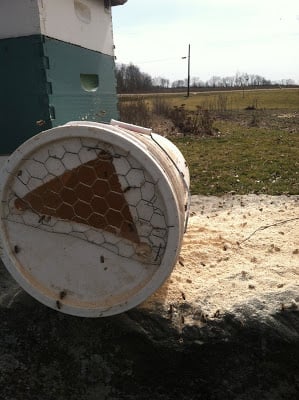
This is dry protein powder, Bee Pro. When there is nothing out there blooming the bees are crazy about it, bringing loads into the hive. Every bee yard gets a bucket this time of year, but it only works well for a couple of weeks on a few warm days. As soon as the first reliable natural pollen becomes available (maples), the bees won't touch it. The chicken wire keeps rodents from getting a free meal.
I've got hundreds of pounds of it to later turn into protein patties. This stimulates brood rearing.

Our little "bee pro" poses next to Bee Pro.
Now it's blustery and cold again with intermittent snowstorms.
Hard on bees and people both.

Crocus tommasinianus and other Spring time wonders

Honeyrun Farm

-posted by Jayne

It's snowing today in Ohio, but that doesn't mean we can't delight in the wonders of Spring.  I wanted to take this opportunity to introduce you to the wonderful little Crocus tommasinianus.  The best thing about this crocus is that it flowers early in the season, and you can plant it in your yard.  Since it flowers early, the green part of the plant has plenty of time to store energy for the bulb for coming years, which is why you can easily naturalize it in your yard, mow the green part down after the grass begins to grow, and still have it come back every year to reproduce and multiply.  It is easy to grow in all soil types and produces lots of flowers.  I planted 100 bulbs throughout the yard at least 4 years ago, and we still get these impressive little clumps dotting our landscape.  


 Isaac has noticed the bees bringing in some bright yellow pollen, and we believe this is coming from these little crocus.

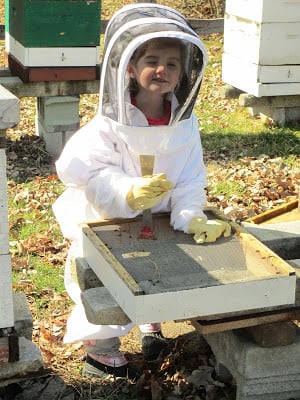
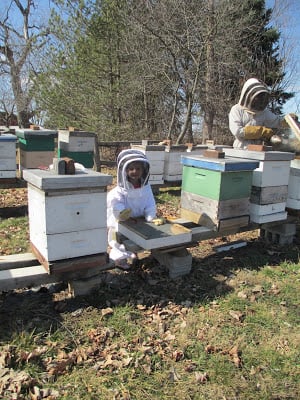
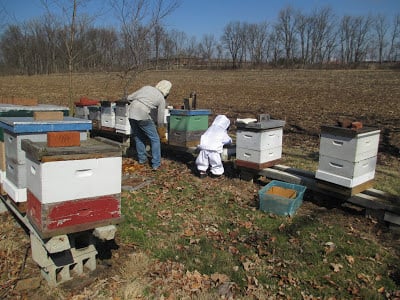
Isaac and Maizy took advantage of a sunny day last week to get in to the hives and check things out.  Maizy is a natural, "Give me that {hive tool} daddy, I know what I'm doing!"


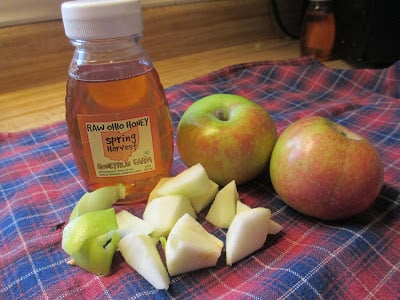
And now a tip for your upcoming Easter pot-lucks.  Did you know that honey can prevent your apple slices from browning?  Since honey contains antioxidants it will slow the browning process.  Of course you can always use lemon, lime, or some other citrus.  But I personally find the flavor of honey a lot more appealing than the tart citrus.  Simply place your peeled and sliced apples in a bowl, drizzle with some honey, and toss.


 Speaking of Easter, did you know we have a new candle in our Etsy store?  Just in time for those Springtime festivities.  Behold, the egg candle!


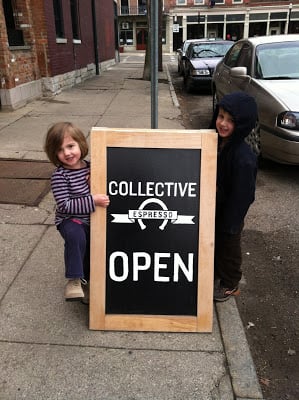
And for our Cincinnati fans; our honey is proudly being served at Collective Espresso.  My cousin Dave just started this new coffee shop in Over The Rhine.  Order some tea or coffee and ask for some honey to sweeten the deal.


Here's to warm weather on the horizon!

What Beekeepers Do For Fun

Honeyrun Farm

-posted by Jayne

This past weekend we had the privilege to travel to Wooster, Ohio, for the Tri-County Beekeeper's Association's Beekeeping Workshop.  I believe it is the largest beekeeping workshop in the state, and having gone for the past 4 years, I would say it never fails to impress.  This year, we were asked to speak on Friday night on the topic "Beyond The Hive" - basically everything we do with our business that is not simply "keeping bees."  We attempted to cover beeswax rendering and candle making, pollen gathering, pollination, making value-added honey (infused, granulated, seasonal), marketing your products, and even honey house construction - all in one hour.  It was fun to be able to present what we've done with our little business.  The best thing about this workshop is that it gives us a lot of great ideas of new projects, cutting edge beekeeping practices, and allows us to network with other beekeepers around the state.  We've made a lot of great contacts and beekeeping friends over the past few years.  
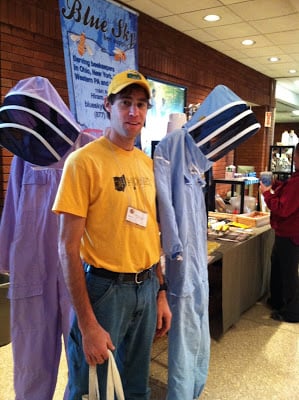
Speaking of "cutting edge" - have you seen these pastel
colored beekeeping suits?  In case you want to "dress to impress"
when you're out in the apiary.
Isaac didn't realize it when we planned the weekend, but he actually ended up speaking at two separate sessions.  He attended a session that was to cover Pollination, and unfortunately, the speaker did not show up.  Ten minutes after the session was scheduled to start, the coordinator of the event came to Isaac and asked if he would mind filling in. Being the amiable person that he is, he obliged.  I wasn't there to hear it, as I was attending a session about making beeswax salves and balms, but from what I hear he did a great job.  

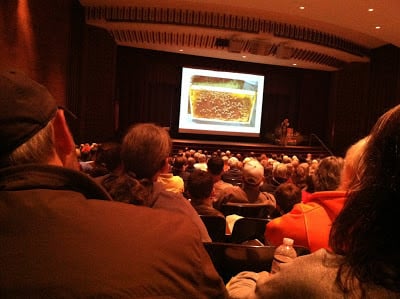
Jennifer Berry was the keynote speaker, discussing "Practical Natural Beekeeping."
Over 1,000 people attend this conference.
After sitting in on the "Making Salves and Lotions" session, I was inspired to go out and buy myself a couple of propolis traps.  Making a propolis salve has been on my to-do list for at least a year, but our propolis trap was lost somewhere in our barn.  So I splurged and bought myself two.  I can still lose one, and hopefully be able to collect propolis.  
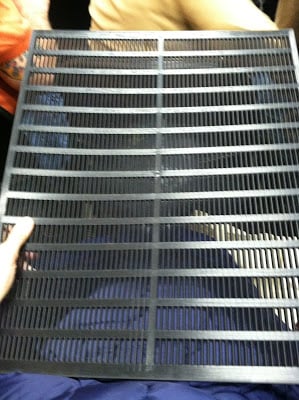
A propolis trap - my "splurge" for the weekend.

The way it works is you put it on the top of your hive, allowing a little crack to let the light in.  Bees will fill any little crack with propolis, which is actually resins collected from trees and plants.  The bees use it to seal out unwanted spaces in the hive, as it aids in prohibiting bacterial growth.  The propolis trap makes it possible to collect propolis in a more usable form, rather than the dirty scrapings of propolis that come from the sides and tops of the wooden boxes.  When the trap is filled - simply freeze it, and then break the brittle pieces out.  The propolis can then be added to tinctures, used in soap making, or infused in oils for balms and salves.  I can't wait to try it out.

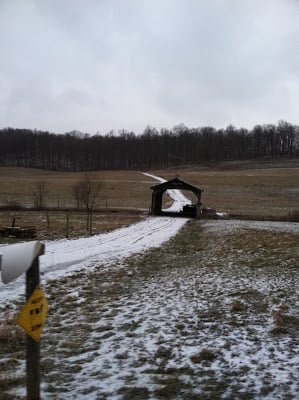
After the beekeeping conference, we visited with my parents in Holmes County, and I found out about the newest little secret in Ohio's local food scene.  There's a new creamery in Charm, and they have a self-serve milk farmstand.  Non-homogenized, minimally pasteurized, grass-fed milk for $4.00 a gallon!  They are called "Covered Bridge Creamery" - hence the covered bridge across the road from the farm.  They are located near Guggisberg Cheese - I don't have an actual address but if you'd like to go just email me and I'll get you the details.  
The bridge at Covered Bridge Creamery in Charm, Ohio
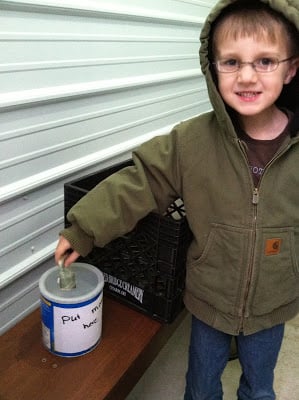
 They have a simple room next to the barn where the cows are milked - no signs or anything- so I believe it is set-up for friends and neighbors rather than tourists.  Inside the room is a refrigerator filled with gallons, half gallons, and pints of whole milk as well as flavored milk.

Just put your money in the coffee can.  I love it!
Since it is not homogenized you have to shake it up before you drink it.  Tonight at dinner, Maizy was drinking from a cup we had put back in the fridge a few hours earlier, and a good amount of cream rose to the top.  When I gave her the cup at dinner time, she took one sip, looked at me in confusion, and exclaimed, "There's a piece of butter in my milk!"

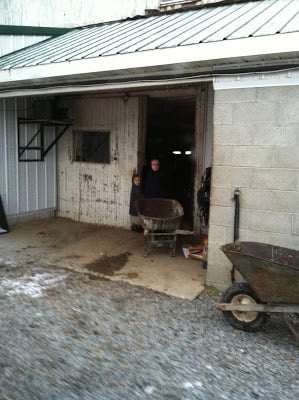
And I know I'm not supposed to snap photos of the Amish, but I couldn't resist a pic of these cuties as we were leaving the farm.  Growing up in Amish country, I always thought being Amish would be the worst thing in the world.  No cars, no electric, no TV.  
Now I think it sounds pretty wonderful.

Tupelo Honey, Boiled Crawfish and Running in the Big Easy

Honeyrun Farm

-Posted by Isaac

While Jayne was churnin' butter, slaving at the Saturday markets and watching kids, I went on vacation. 
New Orleans.        
Man, I love this job.
The excuse was to run a race. Many of you know my sister Becky from Dangling Carrot Farm. Last Friday we took off for the deep south, and by Saturday afternoon we were walking Bourbon Street in the French Quarter.

C'mon, Becky, we've got a race to run!
Although Becky had some difficulty looking past the liquor and male strippers, I turned my more refined tastes to finding something special. Something southern. (No, not Southern Comfort)
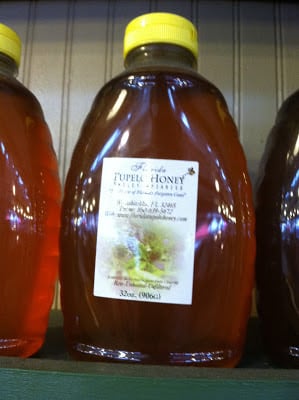
After much searching, I found it: tupelo honey

 Remember that old Van Morrison song? ("She's as sweet as tupelo honey...  she's an angel of the first degree...")
I used to sing it to Maizy at bedtime until she decided she didn't like it. "I'm not an angel!"
Van Morrison did southern beekeepers a favor by making it known to the general public, but among most beekeepers the honey was already famous. It's got a delicate, unique taste and is only produced in the swamps of northern Florida and Louisiana, making it really hard to find.
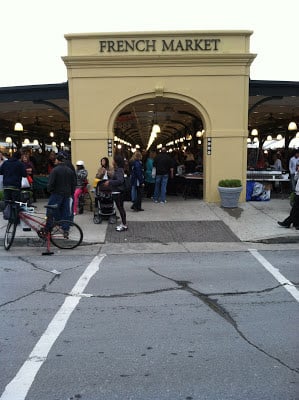
We searched the city over and finally came across some rare tupelo honey here:

This was a fun place. New Orleans' French Market is a little like our own Columbus North Market, but here, prices were set a bit too high in my opinion.

Ouch!
Oh, well. It's New Orleans. Whad'ya expect... dumb yankee tourists.

I like to get my money's worth when running. I chose the full marathon. Becky, more intelligently, opted for the half.
An interesting running note: If you paid much attention to the Olympics last summer, you may have heard the name, Mo Farah. He's from the U.K. and won gold medals in both the 5000 and 10,0000 meters. Pretty incredible. Well, he showed up in New Orleans. That's him in the black-- on his way to a course record half marathon win.

Mo Farah - 1:00:59 - Course Record
Becky joked that he was lucky he didn't run the full marathon... he'd have me to contend with.  Ha ha.
My less rushed pace enabled me to occasionally get a whiff of the flowers.
Here's a field of clover in full bloom on Feb 24! No wonder some beekeepers go through the hassle and headache of moving their bees south for the winter.


On any trip, and especially down south, you're of course obligated to sample the local menu. Our pre-race meals consisted of sausage jambalaya, shrimp gumbo and a catfish Po Boy at a little place just off  Bourbon St.
After the race we left town to find some fresh authentic seafood.
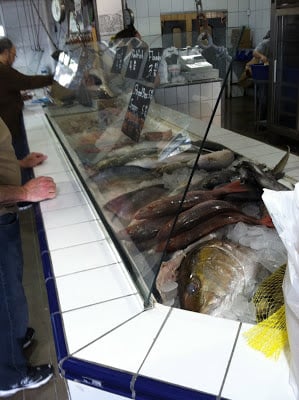
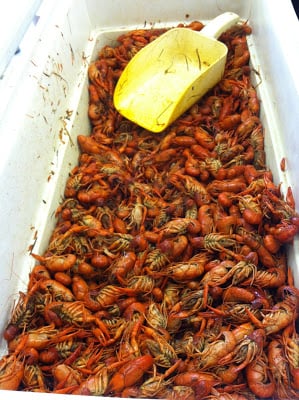
All fresh at Kenny Seafood
 When we pulled into the crowded lot around noon, we had to dodge the trucks pulling boats behind-- the fishermen were still dropping off the morning's catch. Crab, shrimp, many kinds of fish and of course, crawfish. Yum yum.

I got talking to one guy, a crab fisherman, and he was feeling pretty down about the catch this winter. He was unloading crates of crab amounting to what he thought was around $450 worth. "That doesn't sound too bad," I said.
"Well, considering it costs $500 to run the boat and bait the traps, I'll call that pretty bad."
Fishing and beekeeping... they bear a fair resemblance, I thought to myself.


Rich Fisherman
Poor Fisherman
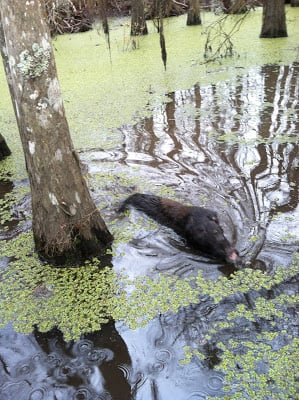
 After we had eaten our fill of Louisiana's finest and left the fishermen deeper in debt, we decided a swamp tour was in order. I was excited to get a look at an actual tupelo tree.
Here they are. The nectar source behind the wonderful rare honey.

Tupelo gum trees
Surprisingly taller then I had imagined, they were just beginning to bud. The bark looked much like our northern white ash. They'll bloom in April and the honey will be coming off the hives in May and June.
We saw many things-- alligators, birds, snakes, jumping fish and marshmallow eating "wild" pigs...


But I continued to irritate our guide with a barrage of tupelo questions.
"It ain't the trees that make the honey, son, it's the bees..."


My sister- an American Queen
 Unfortunately we missed the riverboat ride home. Had to drive.

How to Make Your Own Butter and Honey Butter

Honeyrun Farm

-posted by Jayne

We are often asked if we make and sell honey butter.  The answer is no... we do not.  But we do make our own butter from time to time, and adding honey to create honey butter is very simple.  If you own a food processor- making butter is very easy.  The most important ingredient... well the only ingredient is a high quality whipping cream.  I feel very fortunate to live in an area where we can get minimally processed milk and cream from grass fed cows.  Growing up on a dairy farm- I have always had a love of dairy cows and dairy products.  My favorite foods are cheese and real freshly whipped cream (confession- It's not honey!).  I seriously feel sorry for those who think that the only forms of whipped cream are Cool Whip and Redi-Whip.  How sad!  
Now let's whip some real cream.
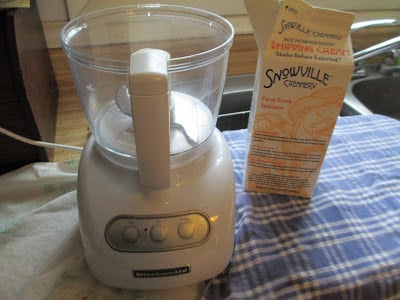
Two necessities for butter:  agitator (food processor) and whipping cream


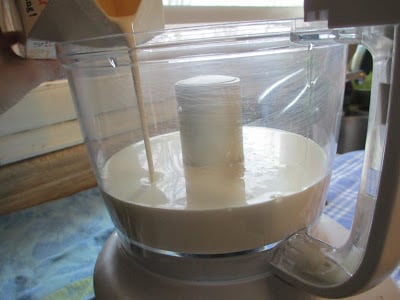
 Step 1.  Fill your food processor about 1/3 to 1/2 full of whipping cream (no more).


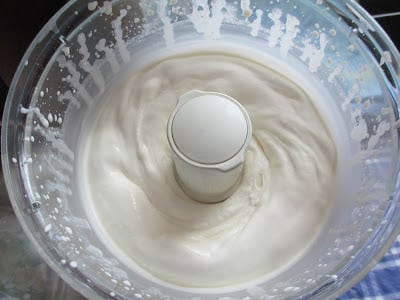
Step 2.  Turn on your food processor (lid on, of course) until the mixture resembles a glossy, creamy state.  This, my friends, is freshly whipped cream.  If I'm not making butter I  usually like to stop right here, add a few Tablespoons of sugar, and enjoy a healthy spoonful of whipped cream.  I freeze it in dollops on a baking sheet and store it in containers in the freezer for use on hot chocolate or in homemade mocha drinks.  But today we'll move past this stage on to butter making.


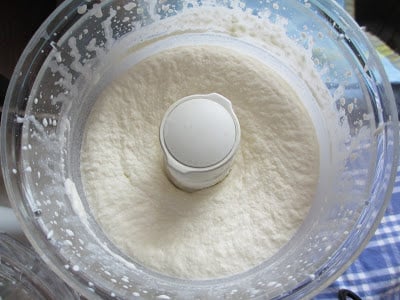
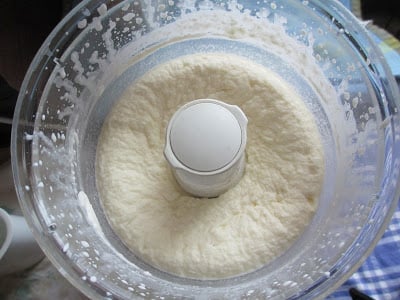
Step 3.  Keep the food processor churning.  You will notice the glossy whipped cream state moving to a ricotta type texture (not quite as thick as ricotta-but the same look).  You can stop and admire the change for a bit... but you must keep churning if you want butter.


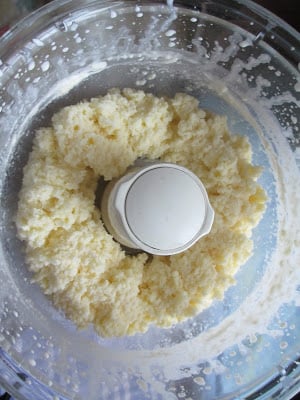
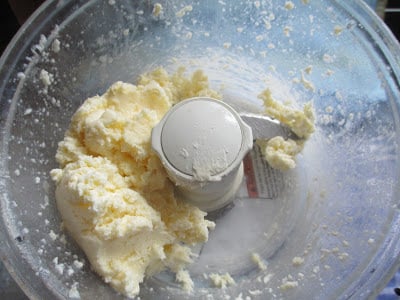
Step 4.  Keep it churning.  Here you see it starting to separate just a bit.  It's only been churning for 2-3 minutes at this point.


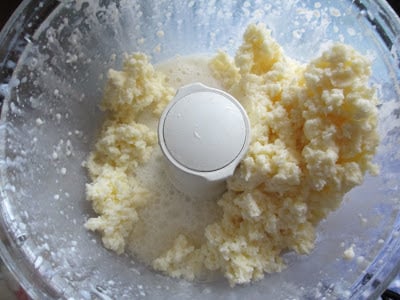
Step 5:  Wah-la!  Here it is starting to solidify.  The color is turning a creamy yellow color, and the buttermilk is starting to separate off from the butter.  Have you noticed we have done nothing more than click a button and observe the changes?  Food processors are amazing!


Step 6:  Here you can really see the buttermilk separating.  Now we actually get to do something.  Remove the blade from your food processor and pour off the buttermilk into a dish (NOT down the drain!  Save that good stuff!)  You will put the food processor back together and continue to pulse the mixture until more buttermilk separates.  Continue to pour it off, about 2-3 times.

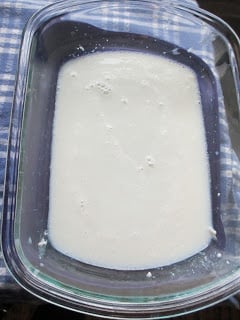
Here is the buttermilk- ready to use in biscuits or baking.
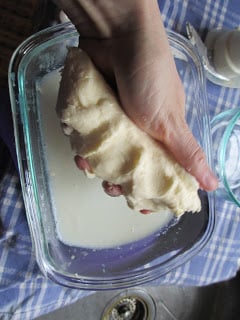
 Step 7: Now you are almost done... but there is still a little bit of buttermilk left in the butter.  Remove your blade, and really wash your hands, because they are going to get dirty.  Remove your wedding ring or anything else you don't want to get slimy.  Squeeze the butter to remove excess buttermilk.


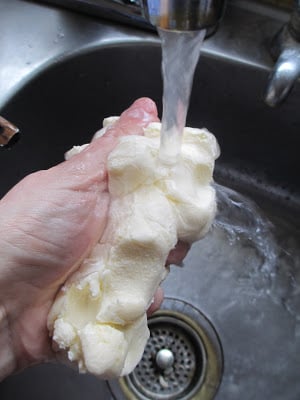
Step 7:  You still need to wash your butter.  Get your tap water running very cold.  Hold your butter under the running water and squeeze as the cold water washes through it.  You are washing out any excess buttermilk that is left.  I read somewhere that if you don't get it all out, it can cause your butter to spoil prematurely.  Just keep massaging and moving the butter under the water until you notice it is not releasing any moisture.  It will be soft and pliable, and not overly sticky.
Wash that butter.
 Step 8:  When there is no liquid left in the butter, you can shape it in to your desired shape, or.... you can add honey to make honey butter.


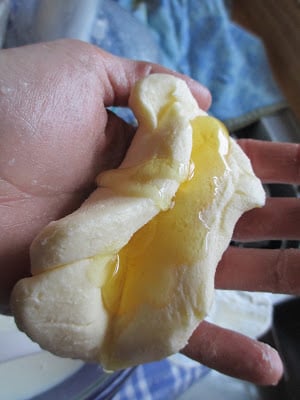
Step 7:  Simply squeeze a generous amount of honey over top your butter, and squeeze it until it is completely combined.  It really is that simple!  Re-shape your honey butter, and store it in a container in the refrigerator.  I have kept mine over two weeks... I imagine if you use good quality fresh cream, it will last much longer.

Please feel free to ask any questions if anything in the directions isn't clear.  The whole process is really quite simple and straightforward.  I know I am being redundant here... but using a local, high quality cream will make all the difference in the ease of your butter making, as well as the flavor quality.  Enjoy!