Contact Us

Use the form on the right to contact us.

We respond to most emails within 24 hours.  

9642 Randle Rd
Williamsport, OH, 43164

Honeyrun Farm produces pure raw, honey, handcrafted soap, and beeswax candles in Williamsport, Ohio

Blog

Honey is for Lovers

Honeyrun Farm

-Posted by Isaac

Happy Valentines! 
Is honey a good Valentine's gift? Whole Foods in Dublin thinks so. Check out this new end display featuring Honeyrun honey and Paromi Tea.

Just in time for you Columbus lovers.
I grabbed some tea for Jayne ("...fragrant and flavorful, perfectly balanced to indulge your senses."), and some French made organic chocolate truffles. Aren't we spoiled?
The kids don't like the truffles, so they tend to stay around longer.

Good choice, Maizy, good choice.
 We've been feasting on chocolates and home made bread this week. Wonderful meals made by Jayne and date nights in Columbus. I used to think Valentines Day was kind of dumb, but my opinion changed after getting married. It has become an entire Valentines week in which we get a few breaks from the kids (thanks to Grandma) and spoil ourselves silly.
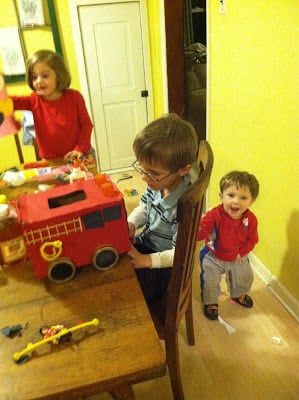
Speaking of kids, Mason, Maizy and Bridger busied themselves with Valentines fun.

Mason's fire engine card box
 Mommy was the parent in charge of Mason's big pre-school Valentines party.
And lucky Maizy gets to go along for the fun and games.
And treats.
Oh, boy...

The party is this morning. I'm watching Bridger while Jayne and the kids get sugared up.

Mason, you heart throb... are you sure it's big enough?
And I can smell that he's left me a little Valentines gift in his diaper.
Better get to it.

A Honey of a Valentine

Honeyrun Farm

-posted by Jayne

Need some creative Valentine's Day gifts ideas?  I have been thinking about some clever "honey collections" one might put together for their special someone.  To start with... Chunk Honey has been a best-seller this past week in our Etsy shop.  It is a nice novelty item for those who enjoy honey.  Simply spread the comb right on your toast and enjoy!


 To pair with the Chunk Honey... an OH Honey shirt, available at Simply Vague in Tuttle Mall.  This shirt was designed by a local Columbus artist, and sold under the label "Statements."  Simply Vague (who also carries our honey) is having a friends and family sale tomorrow, Feb. 10th from 10 am - 6 pm.  15% off your entire purchase.  Just tell them Honeyrun Farm sent you.


And to complete your honey themed gift, an album by the Honeycutters.  The one below is a personal favorite.  I was turned on to this band when they opened for Todd Snider at the Nelsonville Music Festival a few years back.  Folk, Americana style music with wonderful songwriting and vocals from Amanda Anne Platt and her partner Peter James.  I would compare them with Gillian Welch and David Rawlings.  Go check their website here.


 And of course there is always honey soap, beeswax candles, yada, yada, yada.... enough of the sales pitch for our products.

For my own Valentine, I found an excuse to visit our local Candy and Ice Cream shop, Wittich's in Circleville.  Hailed as the Nation's Oldest Confectionery (established in 1830), it is replete with all the nostalgia of an old-fashioned 1930's soda fountain, and they make all their chocolates right in the store.


We sat at the counter and enjoyed their legendary ice cream sundaes...


And of course brought home a box full of chocolates for Daddy...


And since we already own the Honeycutters album, I decided to buy Isaac the Lumineers album he was raving about in an earlier post on this blog.  Remember that?


It's better to feel pain   --  than nothing at all...
The opposite of love   --  is indifference...


Hoping this Valentine's Day doesn't find you indifferent.  

Skunks and Bees

Honeyrun Farm

-posted by Jayne

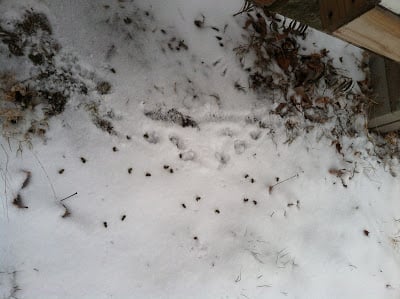
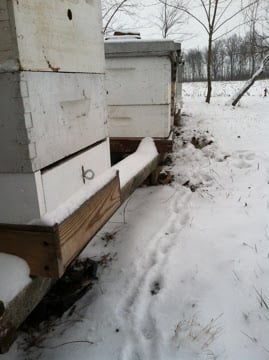
Earlier this week, Mason and I went out to look at the hives, and found some tracks in front of and around the hives.  My first thought.... skunks.

Did you know that skunks love bees?  I remember hearing once at a beekeeping conference that skunks can eat the entire population of a hive in just 3 nights.  I also read on bee source that another sign that you have a skunk problem is little piles of dead bees, as the skunks suck out the juice and then spit them out.  I have also heard that they eat the entire bee, and don't mind getting stung.  

Piles of dead bees:  Skunk carnage.
Breeding season for skunks is from February through May, and they can travel up to 5 miles during this time.  We often start to smell skunks more often during this time of year, and see them around the farm.  If you are a beekeeper, it is a good time to start monitoring your hives for skunk damage.  I believe they are less of a threat when it is cold and the bees aren't flying, since they are less likely to come out to defend the hive.  But the snow will help you see tracks from these predators, and monitor what is going on. 

Simple and Broke

Honeyrun Farm

-Posted by Isaac

It's almond pollination time in California. Big business for beekeepers. No, not us, but I do enjoy thinking back. 
Some poor worn out schmuck is right now riding an eighteen wheeler loaded down with about 500 hives. He's been up all night, and now it's the next day, and he's bleakly looking out at a desert road, thinking... what the hell...??
I was that guy for a season of the almonds. You can read about it in last year's 'Super Bowl of Beekeeping' post. Somewhere in those many thousands of miles I was able to draw a song out of the experience. 
So, for our wonderful blog followers, here you go-- a special treat.  Well, maybe...


What Do Bees Do All Winter?

Honeyrun Farm

-Posted by Isaac

What do they do when it's cold outside?
Occasionally we get asked this question at the  winter markets.
Do they migrate?
Do they hibernate?


 Last winter, Jim Tew from the OSU bee lab jokingly told a reporter that wintertime bees mostly  "hang out, drink beer and watch TV..."
This left some Columbus Dispatch readers scratching their heads, and poor Mr. Tew was pressed into explaining what he meant by that for several weeks following.
What he was essentially saying is that bees don't do all that much. No hibernating, no migrating, no foraging. In cold wet Ohio, they mostly just try to stay alive.
Every so often we get a day with the temps rising above 50 degrees, and the bees are able to get out and take "cleansing flights." Our 65 degree January day this week was just the ticket.
("Don't go believin that Climate Change crap!")
("Them scientists don't know nuffin!")
Cleansing flights

With the advent of this tropical January craziness, Mason and I got out to check a few hives.

Mason dons the new bee suit
 Here's what bees really do in the winter-- they cluster. They form a tight ball with the queen in the middle and vibrate their wing muscles in order to produce heat. In this cluster, there is a slow rotation of outside bees working their way in, and vice versa. Producing the heat requires fuel, and this is why bees need a hefty store of honey going into winter. As the winter toils on, the bees slowly eat their way upward through the frames of honey.
Loose winter cluster
Here you can see a cluster that has worked its way up to the top. They are eating their stored honey and are almost through with the protein/ honey patty I gave them in the Fall.

If the hive is light weight, and maybe 20% of ours are, we give them a five pound fondant patty to play around with.

A light hive means the bees have eaten their way through most what little winter stores they had. We make many July and August splits (small hives, new queen), so we sometimes run into this food problem. Especially if the bees, for whatever reason, didn't collect much goldenrod and aster nectar.
If you're wondering, the little ball in there helps with the condensation rolling down the sides of the bag instead of falling  directly on the bees.

As I said earlier, the winter is mostly a fight for survival, and as always there are a few casualties.
This is a small hive that died, not from lack of food, but simply because the cluster size was too small to produce enough heat. Without heat the bees are immobile, and they can't move enough to travel the few inches to their stores. I pulled a frame up to show a cross section of the dead cluster. This cluster was only three frames in width. Way too small.
"The Fallen"
February and March are the critical winter months for feeding and checking bees. The queen has been laying, and the brood nest size is increasing. The bees instinctually keep the brood warm above all else... even eating. If we get a two week cold snap it could spell disaster if the bees are not close to a food source. I'm talking inches.
Therefore, in a couple weeks, things get busy. We go around making sure our girls are fat and happy.