Contact Us

Use the form on the right to contact us.

We respond to most emails within 24 hours.  

9642 Randle Rd
Williamsport, OH, 43164

Honeyrun Farm produces pure raw, honey, handcrafted soap, and beeswax candles in Williamsport, Ohio

Blog

All New for Christmas!

Honeyrun Farm

-Posted by Isaac

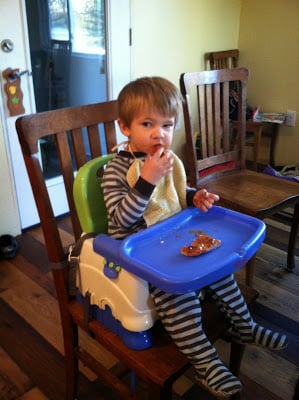
The little elves have been busy at Honeyrun Farm.

Too busy to bother with shoes


We've got two new items to show you.
Just in time for you last minute Christmas shoppers.
Cinnamon honey and a four pound granulated honey.

The 13 ounce granulated honey has always had its niche following at the farmers markets, but now seems to be getting very popular at the Hills Market Downtown and Whole Foods.
When Jayne and I were exploring the Missoula market last summer we came across a beekeeper with a beautiful and artsy display. The focal point being an eye catching large glass jar with water white knapweed honey on its way to granulation. With that in mind, we thought we'd try something gifty and artsy ourselves. Here it is (above). Same granulated summer honey but more attractive and a lot more of it!

The other new item isn't exactly new. Some of you who made it to the Lithopolis Honeyfest will remember the granulated cinnamon honey we had out. Or maybe you missed it... it sold pretty fast.
Well we finally got a sharp new label:
Here it is!

This is wonderfully rich honey. Thick and spreadable, great on the morning toast. Over the years, quite a few people have asked for a raw honey / cinnamon mix... for a variety of health reasons. We plan on having this as a permanent fixture at the markets and on Etsy. I'll soon be approaching the grocery stores. Hopefully most of them bite on it and give us a little more shelf space.

 This Saturday (12/21) is the last market before Christmas. Last year at this time on my snowy and dark way up to Worthington, I skidded the car right through a fence, down a ditch and out into the field. Still made it in time for market, although the car and my mental state were a little worse for the wear. My dear wife won't let that happen again. Jayne is coming with me this Saturday. We're making it a "date." One of us will get to walk around sampling the awesome baked goods while the other (non-pregnant one) works.

So Merry Christmas, and...
We'll see you there!

Leopold by the Fireside

Honeyrun Farm

-Posted by Isaac

Cold week on the bee farm.

I guess we've almost had an all-time record year for snowfall in December. I took the kids sledding this week on a rare pre-Christmas snow day. It was 11 degrees when we took to the slopes.
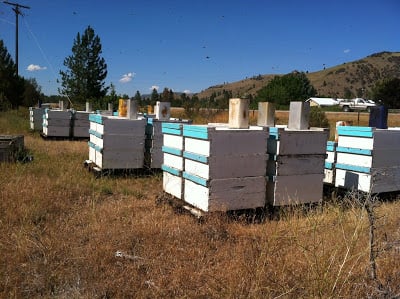
Wondering how the bees were faring the cold, I walked right over to the ridge:

Burning through the food! These hives were fed a sugar patty on November 7th. You can see that this particular hive has nearly finished it. I took too much fall honey from this yard and I'll be working to keep the girls alive the rest of the winter.

I'm often asked what the bees do all winter. Hibernate? Migrate?
Well, neither really... unless the beekeeper is set up to migrate. (Maybe we'll be there someday. I could use some Florida about now.)
What bees do is cluster. They form a tight ball around the frames and vibrate their wing muscles to produce heat. To do this they need food. Ideally plenty of honey. I've had to feed patties to about a fourth of our hives. I'll continue feeding until the days warm and the pollen returns. Seems like a long way off.

I'm never asked what a beekeeper does all winter, or how a beekeeper stays warm... but I'm going to tell you anyway.

I like wood heat.
Sure, the furnace works, but in my opinion the radiant stove is far superior.
As Jayne showed you in her last post, we've improved on our cave, but I hope we never give up on our good trusty fire in the living room.

Bees go foraging for their wintertime heat source and so do we... but we forage all winter.
This week my brother and I launched our efforts on this mighty old oak at Crown Hill Golf Course.

Oak makes some of the best firewood. I've watched this tree slowly die over the years, having grown up just a mile away. I ran past it almost daily the years I worked on the course, knowing its heat would probably warm me one day.
Sure enough, December 11th it met the chainsaw.

When I'm into cutting wood or sometimes simply reading by the fire, I like to think of Aldo Leopold:

“There are two spiritual dangers in not owning a farm. One is the danger of supposing that breakfast comes from the grocery, and the other that heat comes from the furnace.” 
― Aldo LeopoldA Sand County Almanac

If you haven't read A Sand County Almanac, please, check it out. It's one of my favorites. Leopold chronicles the year in his beloved Sand County and his February essay is titled Good Oak.

He expounds on his thoughts, cutting into an old tree, remembering the many years and historical events occurring during the tree's life; the sunlight collected, later to be returned as heat energy from the fire.

"If one has cut, split, hauled, and piled his own good oak, and let his mind work the while, he will remember much about where the heat comes from, and with a wealth of detail denied to those who spend the weekend in town astride a radiator."

About 160 years old. Maybe a Union soldier stumbled by this young sapling.

Four loads of firewood have so far come from this old white oak. At least three more will come out of the mighty trunk. It warms me this very moment as I write next to the fire.

I'll leave you with Leopold's finishing paragraph:

"These things I ponder as the kettle sings, and the good oak burns to red coals on white ashes. Those ashes, come spring, I will return to the orchard at the foot of the sandhill. They will come back to me again, perhaps as red apples, or perhaps as a spirit of enterprise in some fat October squirrel, who, for reasons unknown to himself, is bent of planting acorns."

Pumpkin Honey Pie, Our children as handy-helpers, and a Kitchen Remodel

Honeyrun Farm

-posted by Jayne

I have had many blog ideas in the works over the past 4 weeks, but none of them have really come to fruition.  Life has been pretty hectic and chaotic, but we try to go with the flow and keep on moving.  Etsy sales exploded on Black Friday through Cyber Monday - and I thank our customers sincerely for that!  I am often asked if I can offer coupon codes during that time, but the truth of the matter is - I am so busy trying to keep up with regular orders, I simply can't offer discounts to try to coax more customers to buy our products online with a coupon code!  Don't worry...  I will offer a discount or sale someday soon, but for now I try to keep my head above water... and keep the orders out the door and on time.

So for today, I thought I would re-cap some of the ideas for blog posts that I've had in my head over the past few weeks.

First, there was the Pumpkin Honey Pie recipe I wanted to post before Thanksgiving.  It's the same recipe I posted two years ago (was it really that long ago?!)  I have made this recipe many times and it is a winner.

We like our Pumpkin Honey Pie with a dollop of freshly
whipped Snowville cream (sweetened with honey!)

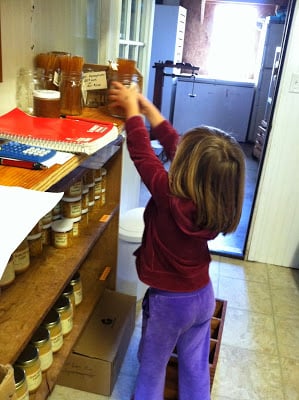
My next blog post idea was one about how our kids have been helping us out more with the business.  We often talk about how our kids accompany us with tasks on the farm, and at times, to be truthful, it is really not much of a "help."  But as they get older, they are enjoying the small jobs like labeling honey jars, filling crates with products to take to market, and even un-molding candles so they can be re-wicked and poured once more.  

Maizy takes the label off the sticker, Isaac labels the jar,
and Mason puts it in the box and gets the next jar ready for labeling.

Maizy pulls honeysticks from the shelf, getting ready to
pack for market.  "Just don't help me with this job
at all mom.  I can do it myself."

Maizy has memorized the right amount of pollens
to pack for our Worthington market every Saturday.
Not forced labor, I promise!  She enjoys it.
 And finally, the blog post I've been planning for months and still haven't gotten close to writing - our kitchen remodel.  We knew when we moved into this house that we wanted to eventually remodel the back end of the house.  We (or maybe I should say... I) wanted to make our kitchen a bit larger so we would have more room for a kitchen table and better traffic flow.  I also hoped we could provide better access to a laundry room where I could easily carry my clothes out back to the clothesline to hang them up to dry.  The existing laundry room had been renovated out of a porch entry-way on the side of the house... around the time indoor plumbing was invented.  Our house is over 100 years old, so the original design didn't take into account bathrooms and laundry and such.  When they changed the porch to a laundry room, they shut out a door and window to our family room, making it very dark and also making for a confusing entry to our house.  No one ever knew which door to use- the cluttered laundry room?  Or come all the way around back into the kitchen?  So after years of nagging my wonderful husband, he finally jumped up on the roof of the back porch and started dismantling it.  This was back in January 2013:


You may remember this photo I put on the blog back in the Spring:  We broke ground in April.

The kids wanted to know: Why is Uncle Perry breaking up the back of our house?
For several weeks our back door led to a big hole.
Watch your step, Maizy!


The foundation was laid and the concrete poured.  This new area is what
would become our enlarged kitchen/dining area, a mud room, and laundry.

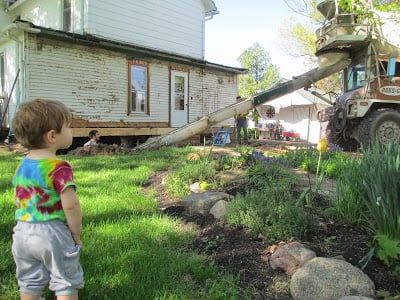
Cement trucks are pretty fun to watch.

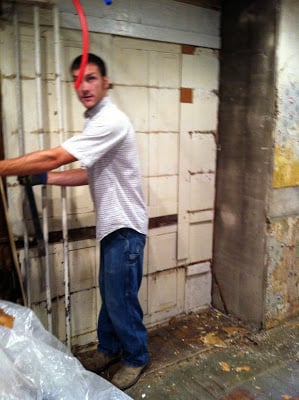
The picture below gives you an idea of just how far we gutted the entire kitchen.  Our house has no insulation.  So the plaster and lathe were removed so we could properly insulate the kitchen and put up new dry-wall.  This little area where our contractor Perry stands was originally a "pass-through cupboard" (I have also heard it called a lazy susan or dumbwaiter). The cooks passed food through a cupboard to be served in a dining room located at the front of the house.  Our dining room is currently used as an office and shipping center (where all the soap, honey, and candle packages on Etsy get packed to be delivered!).  This is partly why we wanted to expand the kitchen- so there would be more room to eat in it, since we rarely would walk to the front of the house to use the dining room.


The back wall was removed... what a fun couple of days that was!

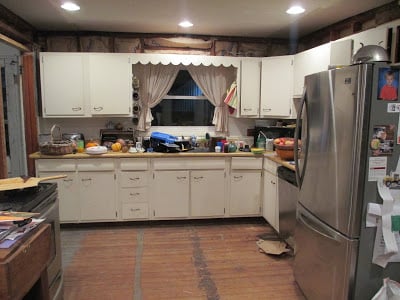
Our former kitchen had 70's style stock cabinetry that I painted white when we moved in (in 2006).  We removed all the old cabinets, and I saved half of them to be used in our new laundry room.  I painted them a nice greenish-blue color, and painted the handles and knobs matte black.  Money saved is money earned, right?

This picture shows our kitchen before we tore out the cabinets, but after
we had torn out the laminate wood flooring.

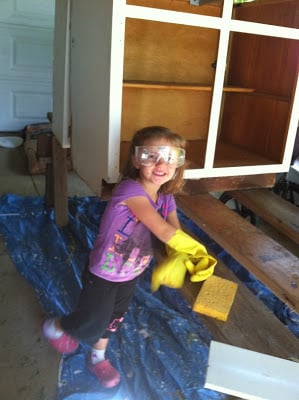
My handy painting assistant.
The picture below was taken by Maizy.  I like it because it shows the random disorganization that took over our honey house area for several months.  Cabinets propped up waiting to be painted, knobs and hinges strewn around Isaac's work bench, trim boards awaiting stain.  We still have piles of old water pipes which were removed from our basement, sitting near the drive-way awaiting a trip to the recycling center.  


I was without a kitchen sink for nearly 2 months.  I have discovered that nothing happens as planned when doing a renovation of this size.  I tried to be a gracious, patient wife, while bending over and washing dishes in the bathtub.  Our contractor (Isaac's cousin Perry) finally made me a make-shift kitchen sink in our new laundry room while we waited the extra weeks for the cabinets and countertops to arrive.   We adjusted.  These are clearly first world problems, after all.

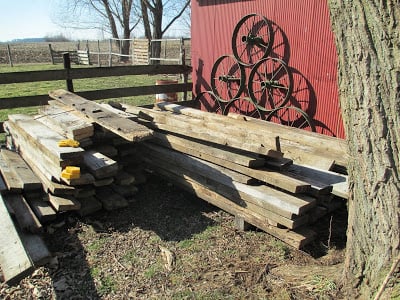
Back in February Isaac picked up several truckloads of oak barn boards from 
an old barn that had fallen down on St. Rt. 104.  We had these boards planed by
Schlabach Woodworks (near my hometown) and made into
hardwood flooring and countertops for our kitchen.
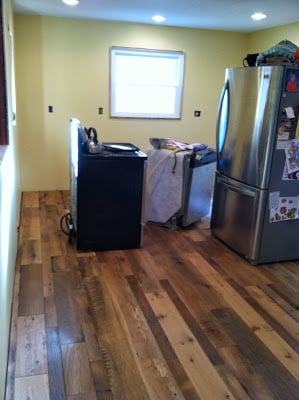
The kitchen- after the new flooring went in but before
the kitchen cabinets arrived.

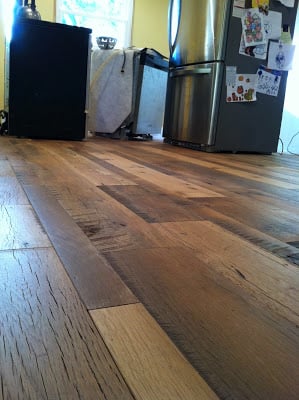
Close up of the floor.  It was planed just enough to make
it smooth enough to clean and walk on.  But you can still see
the saw marks and wear of the barn wood.  I love it!


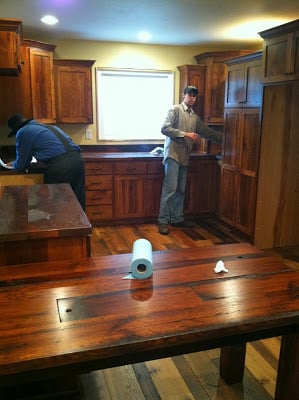
This picture was taken the day our cabinets and countertops
 were installed. Our Amish craftsman, Eldon Hostetler was
figuring up our bill (ouch, that's a lot of honey money!)


 So we're not completely done with the remodel, but it is getting close to being finished.  I finally have a kitchen sink again.  I'm attempting to organize and make sense of this amazing space.  I hope you enjoyed this little tour of our remodel project!  I know I always enjoy reading about others' remodels on blogs.  If you would like references to any of our project contractors I have links and phone numbers listed below:

Flooring:  Schlabach Woodworks (if you want flooring like this you need not gather the barn wood yourself- they can source it for you).  6660 SR 241 Millersburg, OH 44654, Phone: 330-674-7488

Cabinets:  E Hostetler Woodworking- Mt. Eaton, Ohio - 330-698-3661 (He is Amish so this is just a message phone- he has no website or Facebook page for this reason as well)

Perry Barnes Construction: Isaac's cousin- general contractor and general problem-solver.  Send us an email if you want his contact info.  He is currently pretty booked up with local business!


Bridger T. Mountain Man

Honeyrun Farm

-Posted by Isaac

Two years ago today, my birthday, Jayne gave me the most amazing and precious gift.


 Bridger Thomas Barnes, nicknamed "Bridger T." by my dad then re-nicknamed "Bridger T. Mountain Man" by Maizy who was trying to connect the dots between mountain man Jim Bridger and the name given her new baby brother.
I've got a phone full of Bridger pictures so this being our special day, I thought I'd give the bee talk a rest and highlight our little mountain man in action. He's really becoming accomplished at a variety of trades.

Like:
Wrangler- Leader of men, tamer of the wild:


General Contractor- Hauling rocks, mowing rocks, shop work with Daddy:


Woodsman:

Archer- Training for a future Hunger Games

Scholar and teacher- (when big brother needs help)

Commercial Pollinator:


(and official pollen taste tester)

Proficient Garden Walker:

Technician:

Life Guard:

And of course, Mountain Man: leader of midwesterners through the alpine wilds.

I have little doubt, he'll someday carry me up those rugged slopes.

Let Us Give Thanks For Good Food

Honeyrun Farm

-Posted by Isaac

We all need rich, wholesome and diverse diets.
Everyone--
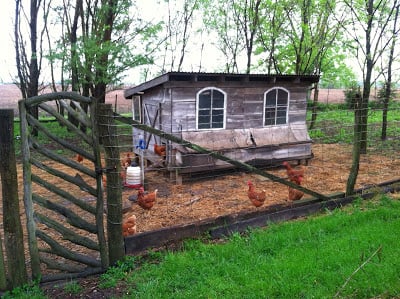
The chickens:

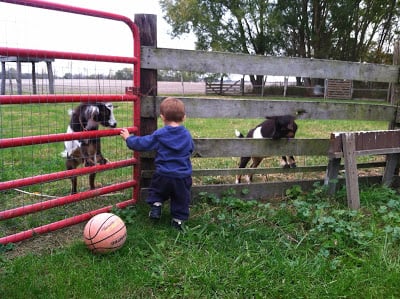
The goats:

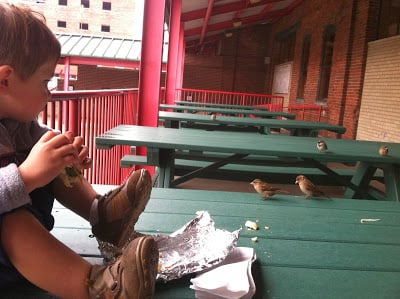
The birdies:

The babies:

 The piggies:

And of course, the bees:
This was an interesting Montana bee yard. The hives had feeders on in the middle of the summer. My only guess is that this beekeeper is ignoring the income (and work) of any potential honey crop and simply prepping the hives for the big pollination money that comes with California almonds.

We're not set up for almond pollination, so we've got to buckle down for another long Ohio winter:

Any well populated hive weighing under 60 pounds or so will need supplemental food.
This constitutes maybe a quarter of them.
It's time to start winter feeding our girls. The patty in the above photo is a sugary blend of fondant, Honey Bee Healthy, lemon juice and cinnamon.
I like to experiment. The cinnamon idea came from Jim Doan, the commercial beekeeper who was interviewed in the Time Magazine article about CCD. He puts a "healthy dose" of protein and cinnamon in all of his hives. Claims the cinnamon is good for the bees' digestion.

Of course in November it's too early to be thinking protein. That will have to wait until March when the bees are brooding up. My hope is that the bees lugged in a heavy dose of ragweed, goldenrod and aster pollen. And so much more to add to the mix... the rich, wholesome diverse diet I started talking about.
The bees know what they're doing.

Incoming ragweed pollen
This is good stuff. Bridger can attest:

But...
Just like humans, bees don't always forage on the right thing. (Who doesn't like Pepsi, Doritos, ice cream, etc...?)
Here I caught them on some field corn in July:

Corn pollen has a low protein content and is basically nutritionally devoid.
Why are the bees on it? Well, that's what's available. As I alluded to in the Big Ag post, sometimes corn pollen is about the only thing out there.
Not good.
 And even worse...
I know at least four commercial beekeepers who blame seed treated crops (such as corn) as the root cause of colony collapse. The seed treatment, a systemic pesticide, ends up in the pollen of the plant... the bees carry the pollen back and at some point in the next year it gets fed to the brood.
Is this really to blame for CCD?
I sure don't know, but it gives me something to worry about. As I said in that previous post, a corn field may as well be a parking lot if you're a bee. My fear (as Jim Doan points out) is that we're now talking about pesticide laced parking lots.

Diversity is the key; variety in the diet for bees, humans and about everything else. Randy Oliver (commercial beekeeper and fantastic educator) talks a bit on the subject in this video:

Now that just made me hungry.


Happy eating, everyone! Make sure you keep some color on the plate...