Contact Us

Use the form on the right to contact us.

We respond to most emails within 24 hours.  

9642 Randle Rd
Williamsport, OH, 43164

Honeyrun Farm produces pure raw, honey, handcrafted soap, and beeswax candles in Williamsport, Ohio

Blog

The Hard Way

Honeyrun Farm

-Posted by Isaac

It's not all fun, games and complaining about things here on the bee farm. At times we've actually had to work. One of the most pressing and important jobs in the spring is making increase. Meaning, building up our hive count. Why?
Before last month's tirade about farm chemicals, you'll remember I was going off about another subject-- the dreadfully cold winter. And the corresponding bee death. We lost a lot of bees!
I found this picture in Smithsonian Magazine:
Look closely at where that icy blue plume is sitting. This was our second polar vortex.
Wow. Go figure.
The only logical conclusion: God hates the Midwest.
And our little honeybees too!

So we needed to build up our bees.
There's an easy way and a hard way to do this. We do both. This post is about the hard way: making splits.

To start, you need a queen.
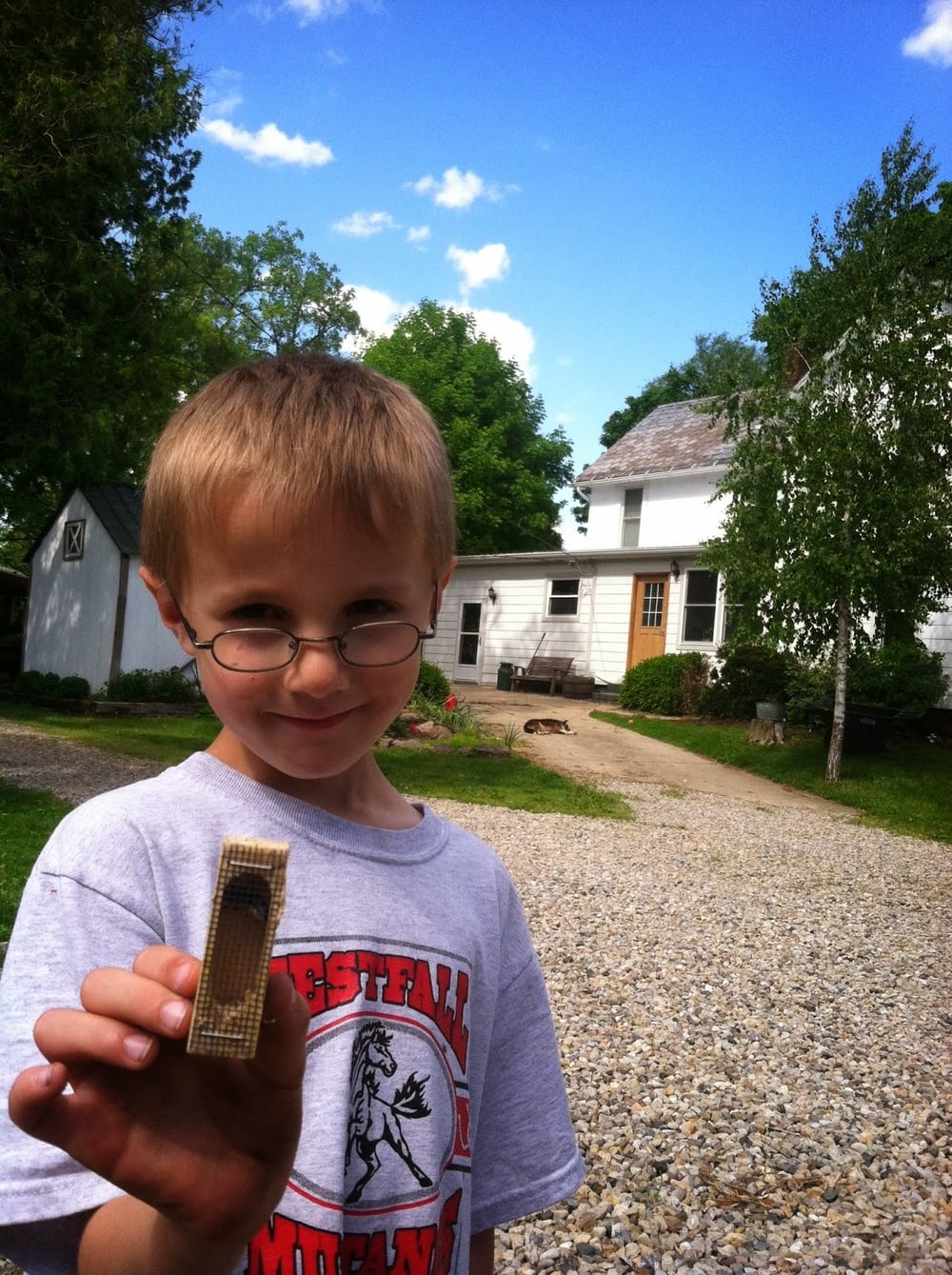
No, a decent laying queen is not always necessary. You can graft, you can introduce cells, you can make a "dirty split." (Forcing the bees to make their own queen)
But in this area, middle of May, a laying queen is the way to go if you want to catch the summer honey flow. We give the California based Koehnen company a lot of business.

The queens can go to the bee yard with you, but you don't want to leave them in the hot cab of the truck.
Don't Do This!
Keep them cool in the shade... but not directly under the truck tire!
 I have cooked queens. I have run over queens.

The equipment for the new splits gets laid out first. This was a yard of 17 decently strong hives.
I ended up driving off with 14 decently strong splits.

I really enjoy the actual splitting process. I offhandedly commented to Jayne one evening about this-- "It's one of the few things in beekeeping that isn't dumb repetitive labor... splitting takes a little skill, a little experience."
One of my favorite jobs and I love it.
Every hive holds its own surprise. Sometimes you're surprised with a big early box of spring honey!


Sometimes the surprise is an unbelievably awesome queen.
Dan Williams has been showing off his brood (strong queens) on Facebook. Thought I'd show you one of mine... she can rival the best of them:
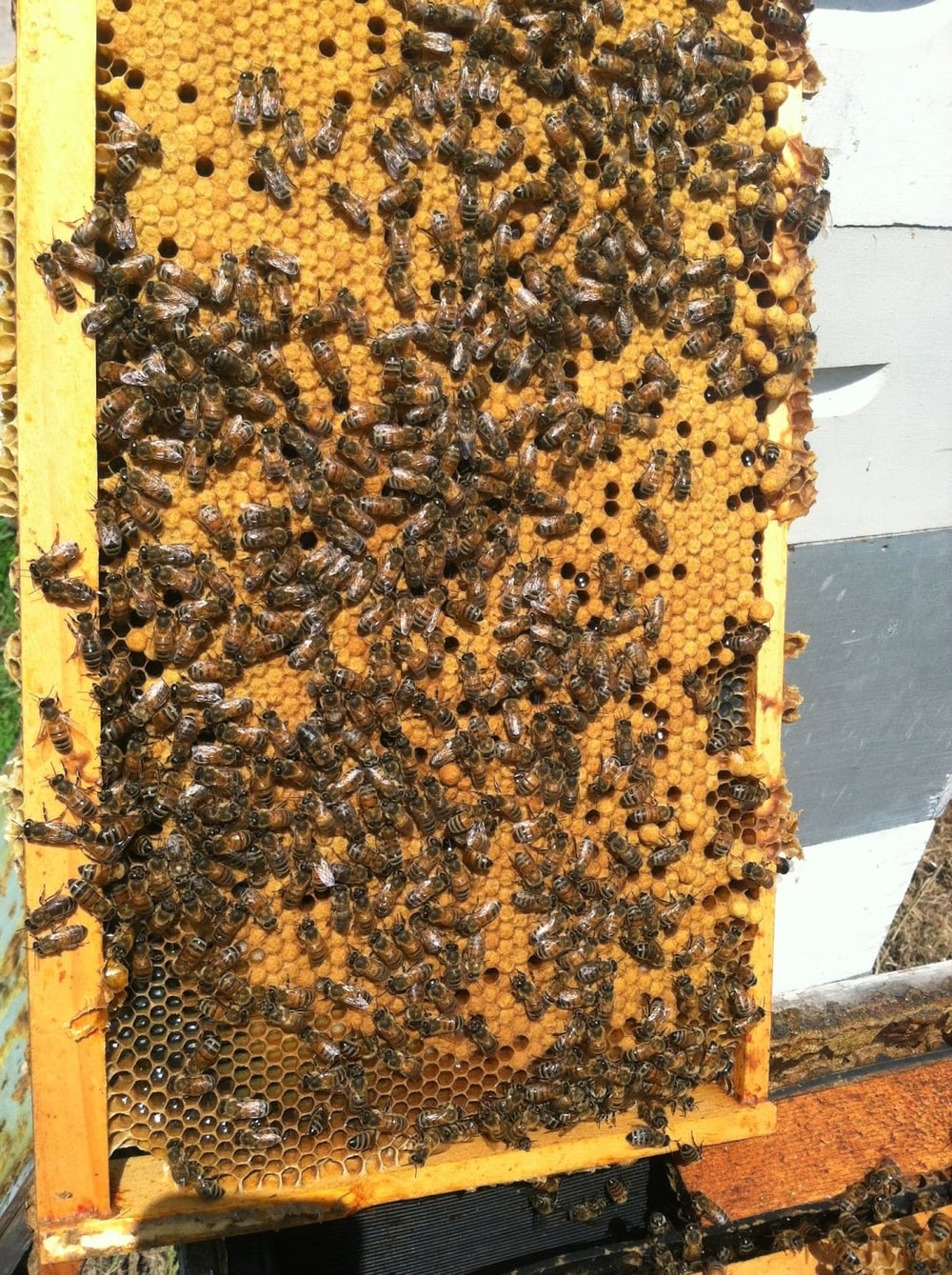
I pulled a frame thinking, wow... good pattern, no swarm cells...
Pulled the next frame--- even better!

At this point I was thinking, Man... I'd really love to meet this girl...

Pulled the next frame. Lo and behold:
"If you got the money, honey, I got the time!"
This hive was definitely a splitter.
Making a strong split involves three or four frames of brood, some pollen, some honey... and it's sure nice to know where the queen is.
Sometimes you find her, sometimes you don't.
The new queen obviously goes where the old one isn't.

It's important to record what you've done:

What the devil?!??

What is this strange cryptic beekeeper code?

About three hours later-- all done.
Hive count is on the increase and another bee yard is out of swarm danger.
For now.

Next we'll look at the easy way of making increase.

Angels and Prostitutes

Honeyrun Farm

-Posted by Isaac

Last year I had the pleasure of sitting in the audience while a beekeeper named John Miller gave a talk about his operation. Here he's promoting a wonderful read by Hannah Nordhaus:


Yes, Miller is somewhat famous. In the small world of beekeeping, that is.
He's also funny and very insightful. He got talking about pollination and the great service that honeybees do for humanity.
"Bees are known as the 'angels of agriculture.' That may very well be... but it doesn't fit us... their keepers. If bees are the angels, I'd have to say beekeepers are a closer fit with prostitutes. The dirty whores of agriculture."
Miller walked back and forth across the conference room, clicking powerpoint slides in quick succession. He was talking about pollination season in the California almonds.
"See if you follow me: -We're dirty. Most of us, I mean. Showers and suits are not on top of the priority list, you know?  -We frequent cheap motels. -We come and go at any ungodly hour of the night. -We work by night, we're gone by morning. -We take their money for services preformed. -And we like quick cash..."
He had the audience laughing. He had me thinking back about my own California almond experience. Yep... the prostitutes of agriculture.

I for one, enjoy the work. I really do. It's kinda hard when you're not set up with hives on pallets like we were in California. These days every hive is lifted by hand, put up on the truck.


And it really is an all night job, as Miller alluded.


But it's important. I love the feeling that what I'm doing matters. Without bees in the orchards, the vegetables, the nuts, the berries... there's a lot less of the good stuff in the diet. Pollination is a valuable service. And it's not like there's a beekeeper around every corner with a couple hundred hives. So it's nice to feel needed.
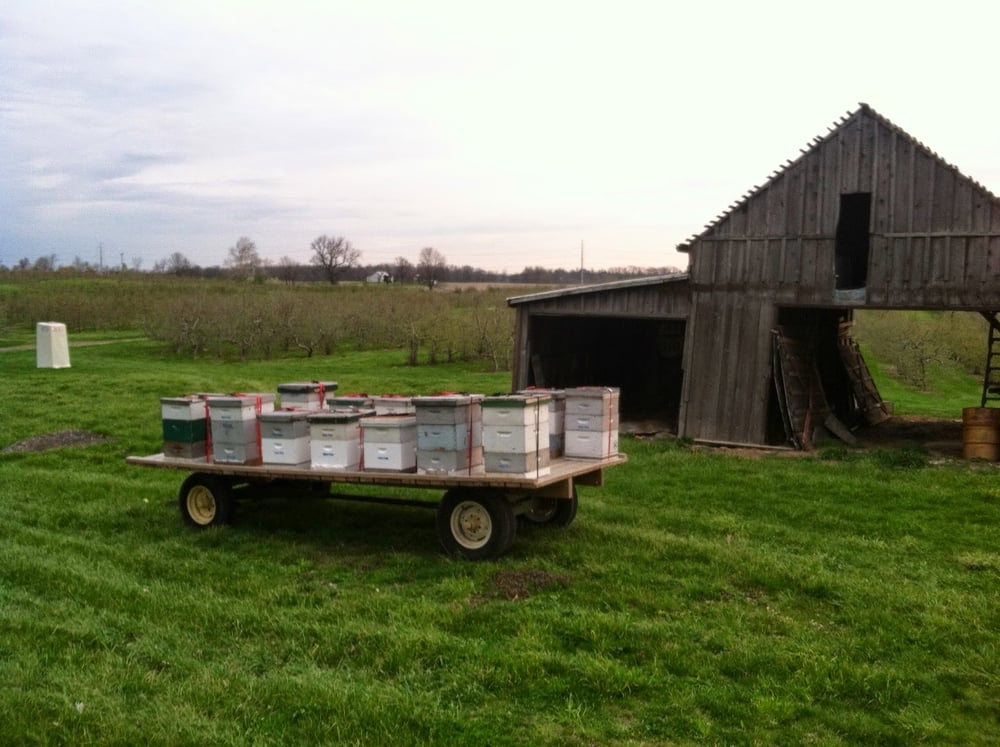
This year we took 120 strong hives into the apples:

At the Lynd Fruit Farm the trees were a few days away from bloom.

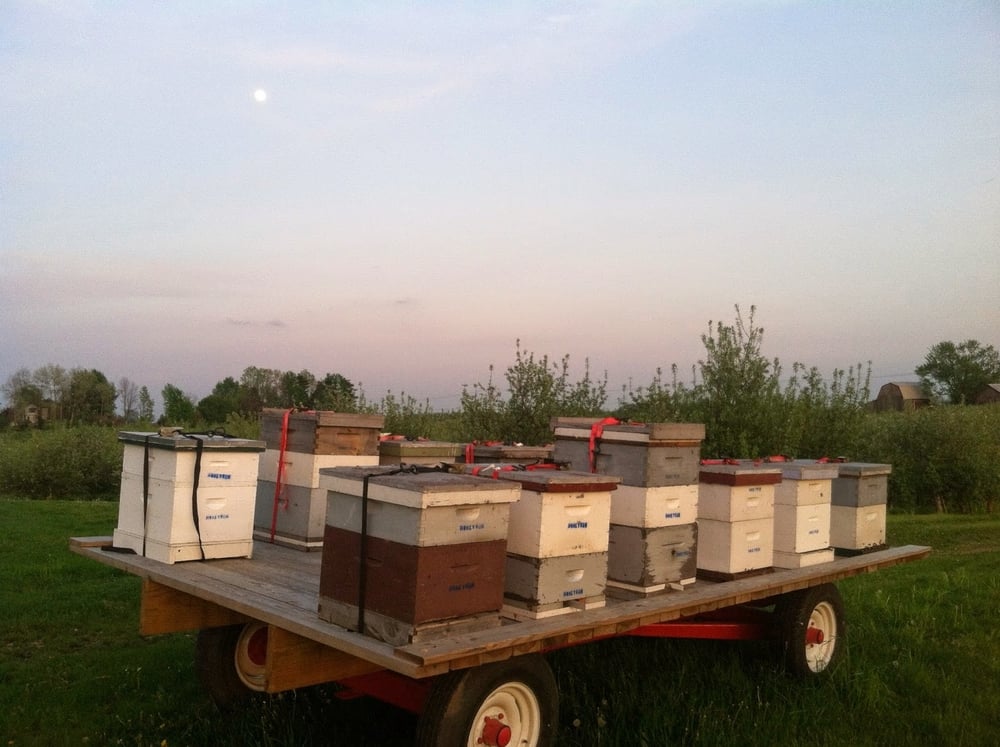
Most of the hives were scattered throughout the orchard on hay wagons. Here, and at the Bachman Fruit Farm.

The bees worked diligently.
Between sun,
and moon.

A little apple pollination perk, courtesy of Lester Lynd:
Thanks, Lester!

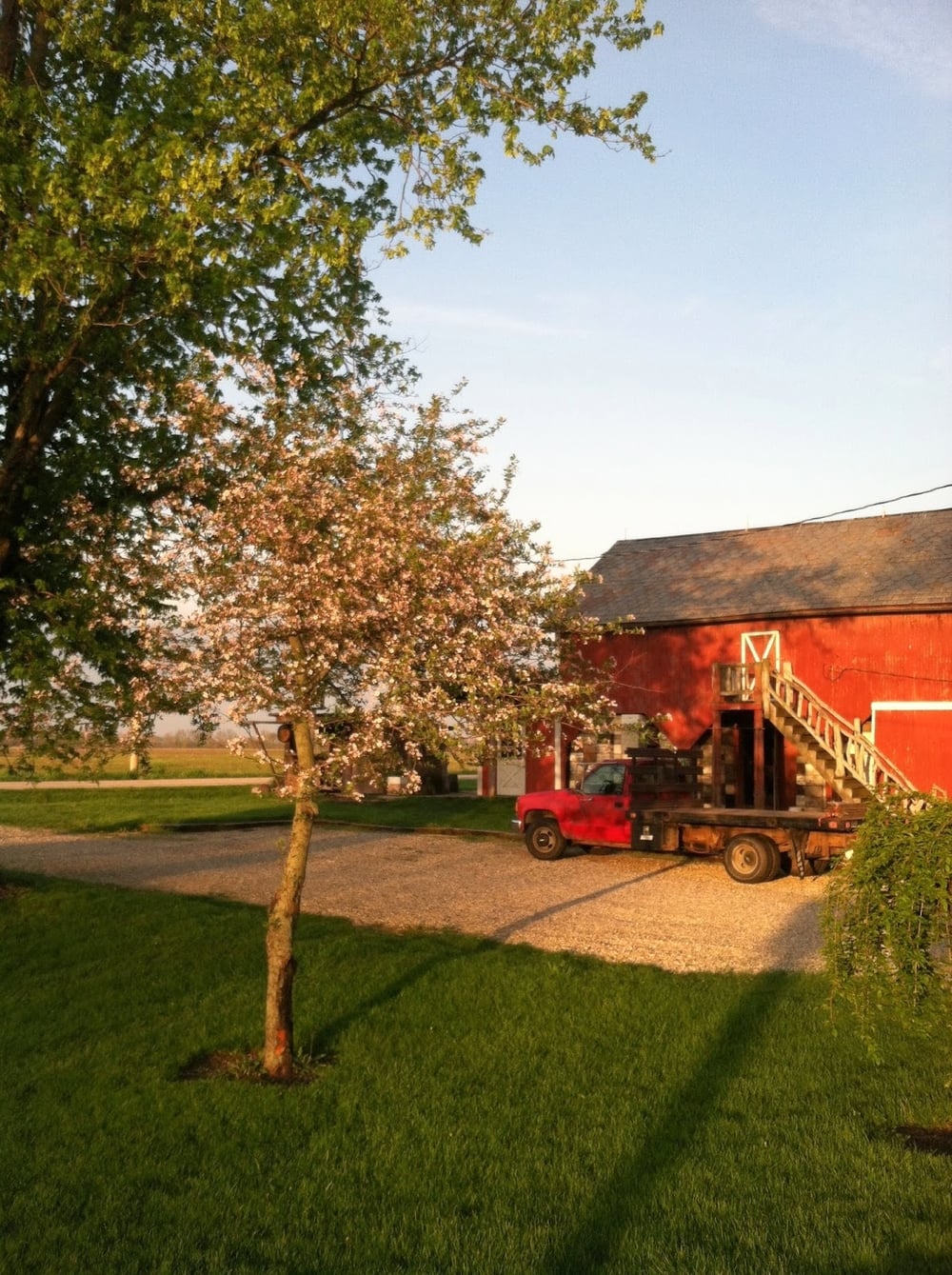
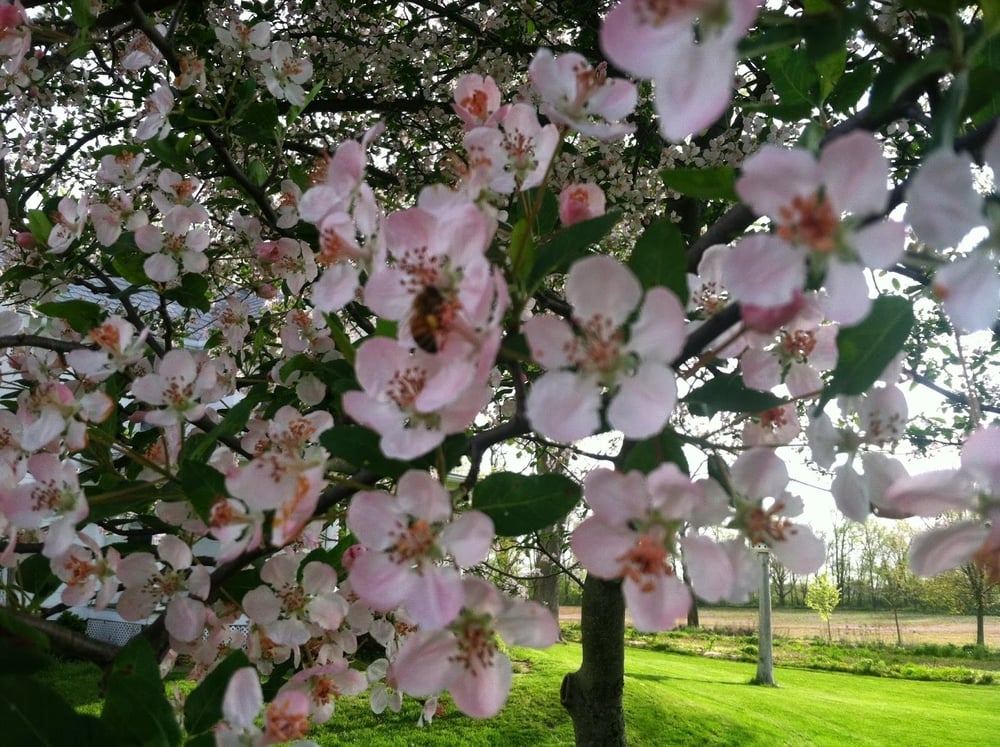
The bees returned home after a couple of weeks. Just in the nick of time for our flowering crabapple.


Another sweet perk of apple pollination:

Strong hives! Many were heavy with honey.

Some of the hives were taken directly to the out-yards where we hope they'll make a good crop of spring honey. Others were promptly loaded back up about a week later and taken south.

The Bainbridge area has a large Amish and Mennonite settlement. And these folks grow a lot of produce.
Ah, those Happy Industrious Mennonites.

Much of which needs bees.
I spent an enjoyable morning driving around with Mr. Zimmerman, placing bees on vine crops.
Beautiful area.
Most growers knew exactly where they wanted the bees.
One guy was ready with a hive stand:

And these guys left little doubt:
Hope they work hard!
The bees, I mean.

Hating on Bayer

Honeyrun Farm

-Posted by Isaac

So here's the stuff that seemed to work:
This was put into the planter boxes in order to better "stick" the pesticide onto the corn seed when planting. Put out by Bayer, it is an honest effort to decrease the "already low chance" of a bee kill. And, of course, it's another product to sell.
Let's applaud them for that.

Now some problems.
After my little bee kill I started really looking into the seed treatment issue. I studied the history. I learned about the specific chemicals. I made calls to beekeepers. I talked to the experts at Crop Production Services. I learned a lot of disturbing things... more than I really want to summarize in a blog post. I found that the Bayer Corporation is the biggest player in this arena. The Neonicotinoid arena. They actually invented the stuff.
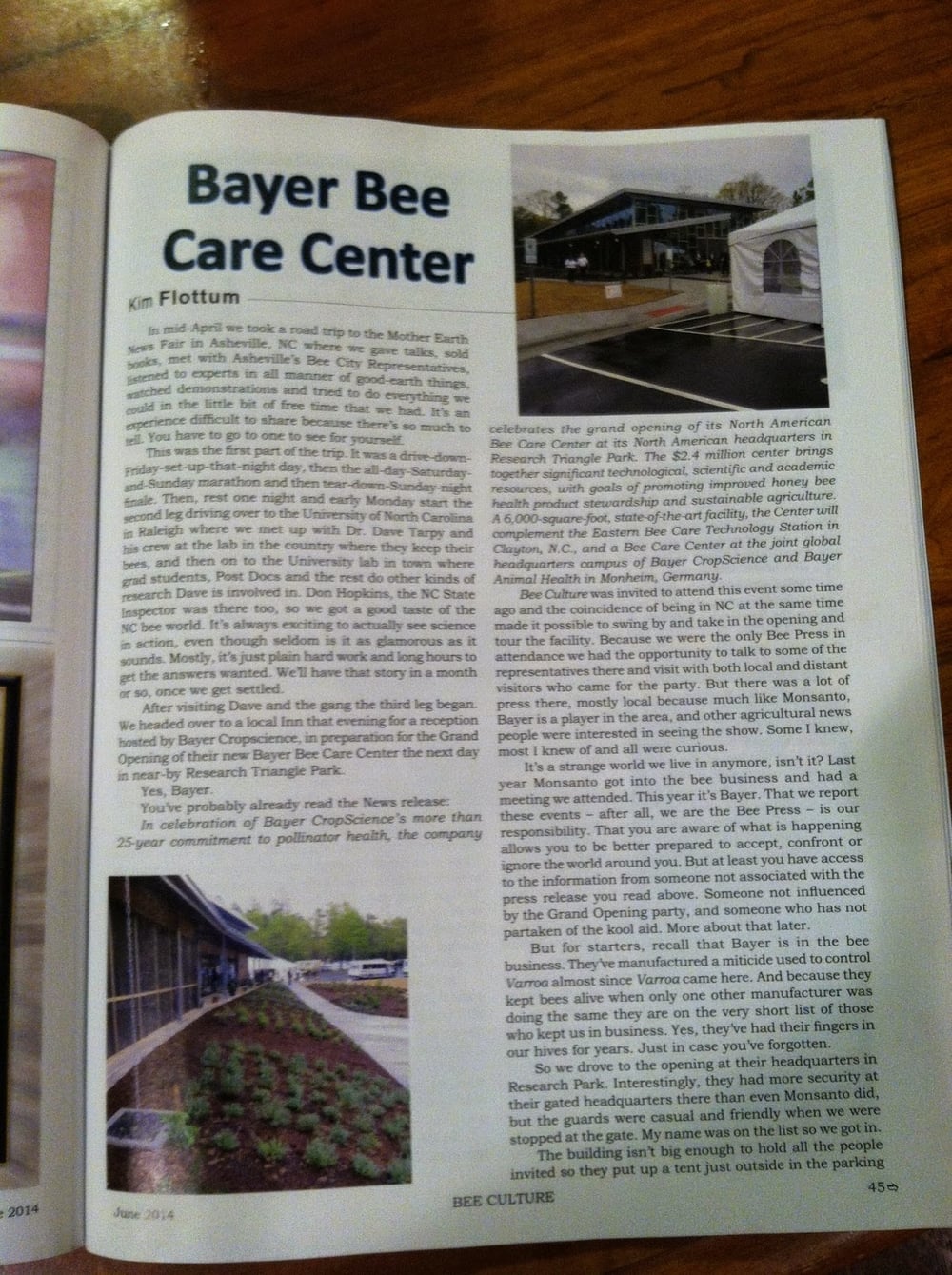
During all this investigation the latest issue of Bee Culture Magazine came out. I start flipping through, lo and behold, guess who's promoting the virtues of the honeybee:
Although I was skeptical, it was good to see Bayer joining another big player, Monsanto, with some involvement in the bee industry. (Involvement that didn't entail the wonderful production of coumaphos and fluvalinate, two of the most bee harmful mite treatments.  -"Committed to Bee Health for 25 Years!")
I read the article.
I thought, wait a minute!... read it again.    
In this article Kim Flottum outlined the many projects Bayer was undertaking to promote bee health.
Why is Bayer doing this?  Hmmm. Because they care? It is an expense after all. $2.4 million for the building alone. I started to really wonder... read the article again!
Not a mention of even one project involving neonics!
This is absurd! Why is the (informed) public mad? - Neonics! What are beekeepers screaming about? - Neonics! What has been banned in Europe due to pollinator kills? - Neonics!
What's going on Bayer?

It fact, you go to the Bayer website, it's hard to find much at all on the subject. A few denials. A few goose chases. Many redirections to, according to them, the real cause of bee troubles-- varroa and nosema. What a laugh!
Bayer has a hugh PR campaign with beekeeping. But it's LIP SERVICE! (As you might have guessed from the #1 maker and seller of neonic insecticides.)
How much did that Bayer Bee Care Center cost again?  $2.4 million
How much did Bayer make last year in neonic pesticide sales? $3.5 billion

Reading the PR and looking into a few of the Bayer products, I did come across several mentions of the  neonicotinoid ability to target "non agricultural" insects. As in... this systemic insecticide kills nematodes but not honeybees.
Wow.
Now that's some extraordinary science.
If you're simply befuddled about how this is accomplished, let me, a former science teacher, try and clear things up:
See, a honeybee comes flying along and...
HONEYBEE: "la la la la... Hi ho, hi ho... la la la la... Oh yummy! Soybean nectar! This will certainly make some mild, bland summer honey for Master Isaac.....   la la la la... Ew, yuk! Corn pollen. Gross! Well... maybe just a little...
NEONIC: "Stop right there, little bug! Agriculture or non agriculture? Papers?
HONEYBEE: "Um... what?"
NEONIC: "You heard me. I'm gonna need to see some ID. Pronto"
HONEYBEE: "Um, ok, let me see here... um... I must've left it back at the hive. Sorry. I'm just so busy, you know... ha ha... busy as a bee.. get it?"
NEONIC: "Must kill."
HONEYBEE: "Hey! Whoa! Lay off, man! We're cool..."
NEONIC: "Must kill babies."

You get the picture.
It's a systemic insecticide! It kills insects! No questions asked.

Here's a five minute review on neonics.

Where is corn planted? Everywhere mid-west. Soybeans? Everywhere mid-west. When did neonic chemicals become used widespread? About 2005. When did colony collapse happen widespread? About 2006. This is not a coincidence! Commercial beekeepers have been pointing at and screaming about neonics for years.
In Europe they did something about it. Here, we're still trying to "pin point" the reasons for pollinator decline.
I mentioned Jim Doan in a previous blog. If you have the time (45 minutes), listen to this very disturbing interview.

On second thought... don't... it will ruin your day.

I got so steamed up I actually called the man himself. (He's not so famous that little ol' me can't talk to him...) We had a good conversation. One thing that stuck: He repeatedly said,  "You have to get your bees out! Leave!" (Montana, here we come!)
"Listen, you cannot survive as a beekeeper when the entire landscape is poison. Simple as that. Corn pollen is poison."
He mentioned encapsulated pollen:

 "Are you seeing more of that these days? What do you think is underneath of that wax? Corn pollen. Poison."

Side note for our customers:  (We collect our pollen that we sell for consumption in the fall, not mid-summer when corn is in pollen)

I didn't feel great about our talk. I felt sunk.
"Commercial guys are actually pulling frames of pollen out."
This is just wrong. Pollen... the very thing bees desperately need to make more bees and survive the winter.

Here's something from the Bayer "fact sheet". You'll be reassured to know that: NEONICOTINOIDS NOT LINKED TO BEE HEALTH ISSUES

If fact, Bayer points to the continued bee problems in Europe as proof that restriction on the neonics was the wrong thing to do.
Ok, clothianidin on corn seed has a half life of around 1100 days! It was used in Europe before being outlawed. I can't imagine why bees (or beekeepers) would still be having problems. 

Another skit:
BEEKEEPER: "Got brain damage."
BAYER CROPSCIENCE: "Sir, your claims and wild allegations of this "head trauma" are completely unfounded. The alleged 'beat down' you speak of happened a full three years ago. And besides, I only took two or three swings."
BEEKEEPER: "Still got brain damage."
BAYER CROPSCIENCE: "You look fine to me.  The doctors on our payroll say you're just fine, and even those other doctors, those independent ones, say you've still got full function of at least 30% of your brain."
BEEKEEPER: "Um..."
BAYER CROPSCIENCE: "Everyone knows that baseball bats are for baseballs. See, it says right here on the label, 'Hard on Balls, Easy on Skulls' We all know THE LABEL IS THE LAW."
BEEKEEPER: "Um..."
BAYER CROPSCIENCE: "In your interest, and because We Care, we have generously donated toward your unfounded claims. Haven't you heard about the new Beekeeper Mental Health and Insane Asylums we've been building? Sure! It comes from .001% of the revenue from our sale of Beat Down Bats... I mean (cough cough) Baseball Bats.
BEEKEEPER: "Um... ok"


Alright, I'm tired of this. All this hating. It's June. It's lovely out. I've learned too much. The rant has run its course and I'm done.
Next I'll fill you in on what we've been doing in the meantime.

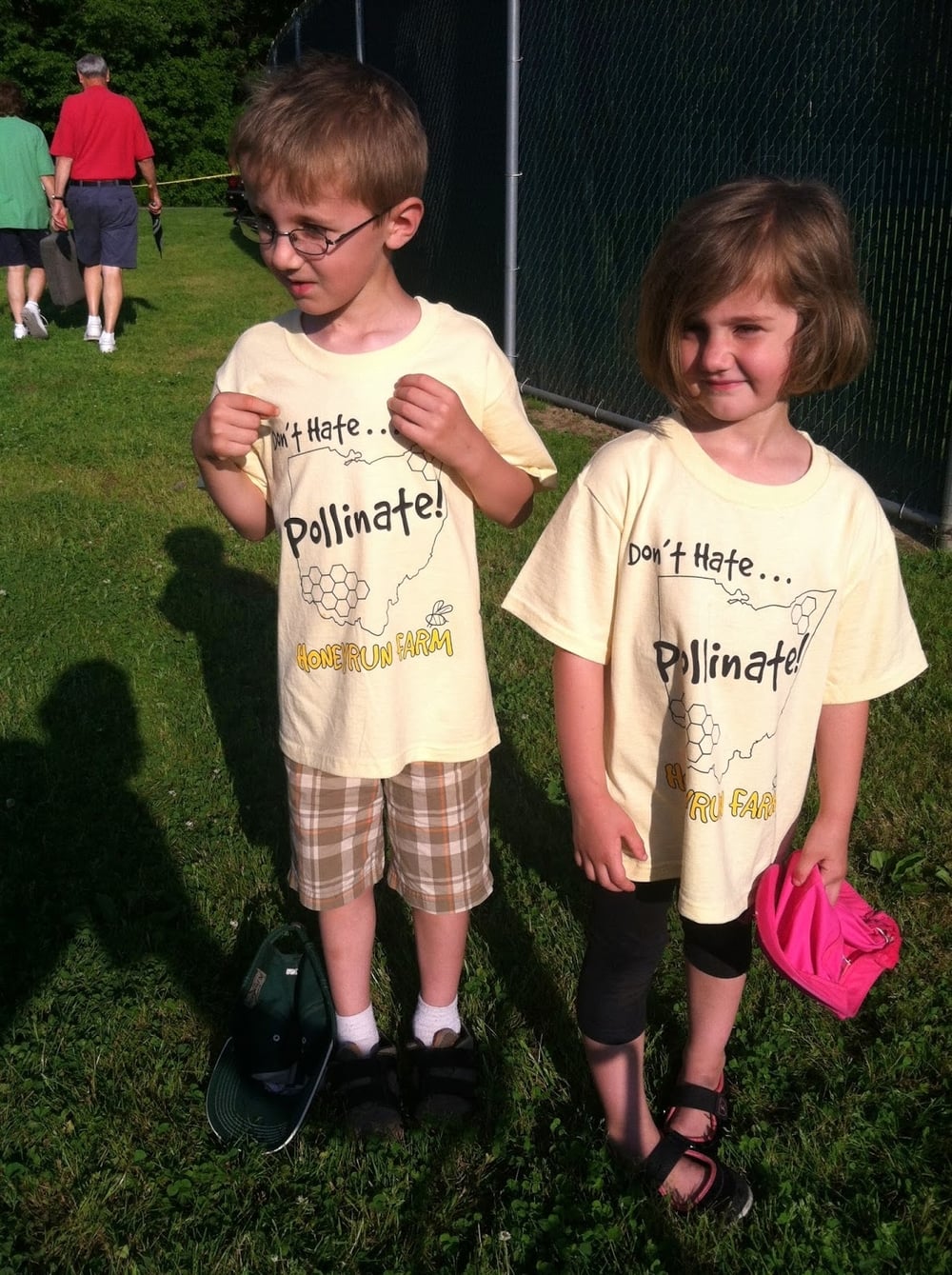
C'on, Dad,
Dont Hate,
Pollinate!

The Results

Honeyrun Farm

-Posted by Isaac

Well, the results are in. Not only from our little corn planting experiment, but the USDA winter loss report made the press this week. First, a little on that...  23.2%

Wow. Now I really feel like a crappy beekeeper. We lost 65% of ours. Jim lost 67% of his. I've talked to two commercial beekeepers in northern Ohio, each with close to 1000 hives. 75% and 79% loss. (And these guys are generational. As in, they know what they're doing.)

Where is this 23.2% coming from? (Well, it says where it's coming from, right on the above website. 7,200 self reporting beekeepers. It's just really hard for me to believe. Especially after the worst winter in recent memory.)

 The bee magazines are reporting higher:
Only two regions were lower then 23.2%... these regions were not in the corn belt.
I don't know. It leaves some of us scratching our heads. And many of us thinking these figures are either skewed somehow or completely bogus
Oh well, enough of that.

The corn planting:
You can barely make out the planter in the background
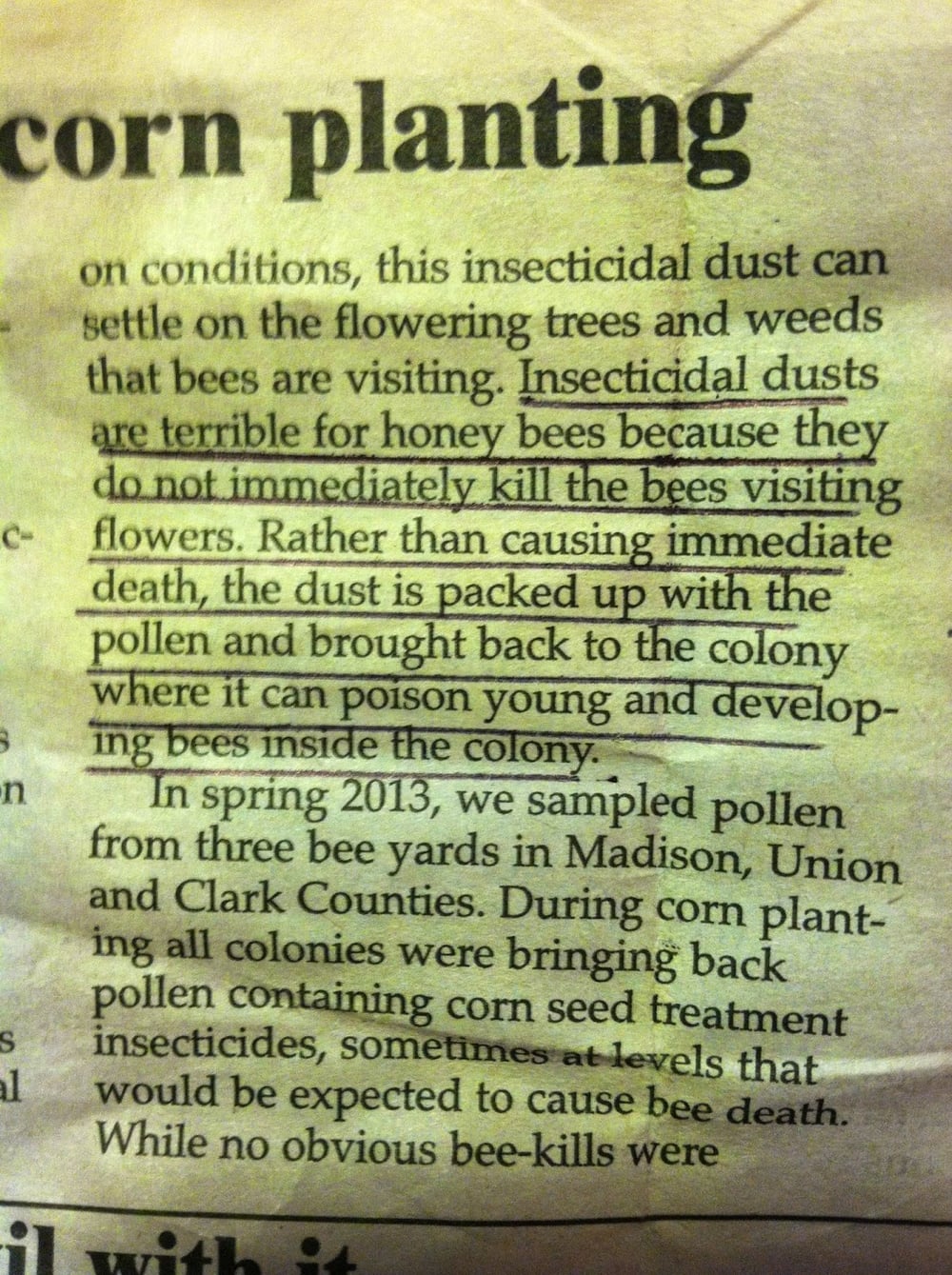
The results were favorable. No dead bees. Well, just a few. But nothing like we saw before. To catch you up, what we tried here was a different seed surfactant. This was a waxy substance, not graphite, not talc, put in the planter boxes to try and control the planter dust problem. Sorry I didn't get a picture... it's in a tractor pulling a planter at the moment. The product is produced by Bayer CropScience. And so is the seed treatment, a systemic insecticide. The thinking is that the dust behind the planter is carrying a little of the seed treatment in the wind. This causes a real problem for bees... as we saw a few weeks ago.

I was working a yard not far away when Adam called.
The big sprayer in the adjacent field gave me some company. And more than a few worries.

Adam had been planting corn for an hour or so when I got there.
Very few bees seemed adversely affected.

A day later:
Still nowhere close to the death we saw before.
Hooray! It worked!
Well... not so fast. There are many different variables to contend with, and this was just one small trial, an extremely small data set. (Don'tcha just love science, Rachel Scior?)
But I am happy that we didn't see piles of bees and I'll willingly praise Bayer for something in the right direction.

This all happened after I got mad enough to fire off a snotty little email to Bee Culture Magazine. What provoked me was an article about the "great" things Bayer is doing for bee health.
                              
It's all lip service! I did some research. I made some calls. The result... I got really angry. I'll share this with you in the next post. (Why stop the rant when I'm on such a roll?)
Thank you to so many who have shared your thoughts and feelings on this chemical issue. You feel marginalized. You feel ignored. And mostly you feel like the environment is becoming spoiled at the hands a few companies. With the government's blessing! I think I'm joining your camp.

Adam found this article in a farm magazine:

He was not ready to rejoice that our little experiment turned out favorably.
As I said... many variables:

And the real issue:
Although the initial bee kill is striking and grabs the attention, this is not the real worry. The problem is what is coming into the hive? What is out there, year after year, pervasive and insidious.

And back to the little complaint I started out with:

23.2%  ???
Mark Twain may help us ferret this one out.

"There are three kinds of lies: liesdamned lies and statistics."


Where are the Good Guys?

Honeyrun Farm

-Posted by Isaac

One more rant and I'll lay off.


Unless our little experiment with the corn planting turns out to be ugly. Then you can be sure I'll be back at it.
This present experiment continues to be ugly:
Bees keep piling up. Foragers and nurse bees alike.

I'm almost ready to call this a true bee kill.

The researchers have gone home. The reporters have gotten their story. The EPA has been notified.

I continue taking samples:
Hey Barbara Bloetscher! Reed Johnson! Robert Miller!
Want more?

But will anything become of it? I'm very skeptical.
And here lies the rant...
It's so painfully obvious that something is wrong here. It was obvious in 2012 with Jim's bee kill and beekeepers nationwide during the last decade.
Something is wrong!
Why are the wheels turning so slow?
Why does it take months to run a test on a few bee samples?

A small beekeeper in podunk Williamsport Ohio garners some attention for just a moment... and then gets ignored.
Big beekeepers, Jim Doan, Dave Hackenberg, scream about neonics... and get ignored.
Jim North had the spotlight:


and got ignored...
Maybe "ignored" is the wrong word. There are people working on this, I know. Very smart people.
But the money is on the wrong side. The good guys don't have the money.

It's hard to read the above article, but one maddening thing that caught my eye was the spokesman for Bayer CropScience.  His explanation for the 2012 dead bees was the early spring: "...bees are coming out earlier and there is not enough available food for them."
Are you kidding?  Not enough food?
There were flowers everywhere! The bees were making honey!
What a load of crap! And that statement actually stood. It got published... and believed! I had a friend who works for the ODA repeat much the same thing when I confronted him with the issue.

What we needed was a good guy. Someone to step in and say, "Um, Mr. Bayer CropScience you should shut up now because you sound like an idiot."
"Bees don't starve in big dead piles in front of the hive."
"Bees don't starve when it's 70 degrees out and the honeysuckle is in bloom."
Where was our good guy? Someone to point the finger, unleash the hounds, make the laws, change the chemicals...
Muffled and choked, that's where. Bayer has the money.

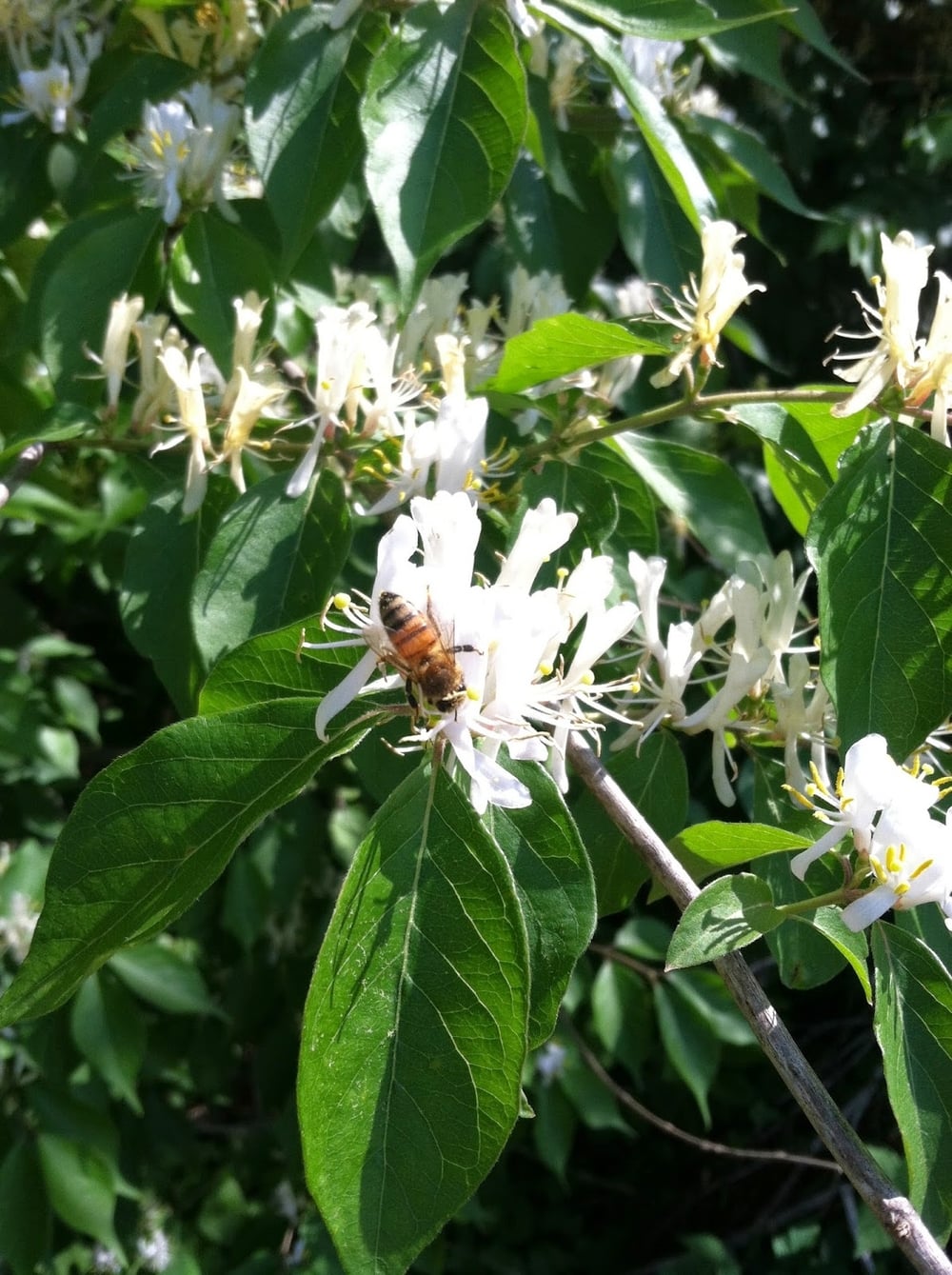
And speaking of honeysuckle. It's blooming!

Bees just love this stuff.

And as I said in that blog post that got all the attention, this plant lines the fields. It's a great thing but could turn deadly... if millions of flowers happen to be catching dust from a corn planter.
 We just have to hope that the bloom and the planting don't coincide. Cross your fingers.

Should it really have to come to that?