Contact Us

Use the form on the right to contact us.

We respond to most emails within 24 hours.  

9642 Randle Rd
Williamsport, OH, 43164

Honeyrun Farm produces pure raw, honey, handcrafted soap, and beeswax candles in Williamsport, Ohio

Blog

Pumpkin Honey Pie, Our children as handy-helpers, and a Kitchen Remodel

Honeyrun Farm

-posted by Jayne

I have had many blog ideas in the works over the past 4 weeks, but none of them have really come to fruition.  Life has been pretty hectic and chaotic, but we try to go with the flow and keep on moving.  Etsy sales exploded on Black Friday through Cyber Monday - and I thank our customers sincerely for that!  I am often asked if I can offer coupon codes during that time, but the truth of the matter is - I am so busy trying to keep up with regular orders, I simply can't offer discounts to try to coax more customers to buy our products online with a coupon code!  Don't worry...  I will offer a discount or sale someday soon, but for now I try to keep my head above water... and keep the orders out the door and on time.

So for today, I thought I would re-cap some of the ideas for blog posts that I've had in my head over the past few weeks.

First, there was the Pumpkin Honey Pie recipe I wanted to post before Thanksgiving.  It's the same recipe I posted two years ago (was it really that long ago?!)  I have made this recipe many times and it is a winner.

We like our Pumpkin Honey Pie with a dollop of freshly
whipped Snowville cream (sweetened with honey!)

My next blog post idea was one about how our kids have been helping us out more with the business.  We often talk about how our kids accompany us with tasks on the farm, and at times, to be truthful, it is really not much of a "help."  But as they get older, they are enjoying the small jobs like labeling honey jars, filling crates with products to take to market, and even un-molding candles so they can be re-wicked and poured once more.  

Maizy takes the label off the sticker, Isaac labels the jar,
and Mason puts it in the box and gets the next jar ready for labeling.

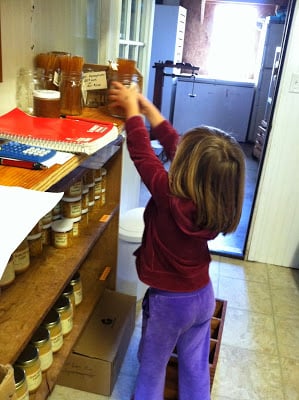
Maizy pulls honeysticks from the shelf, getting ready to
pack for market.  "Just don't help me with this job
at all mom.  I can do it myself."

Maizy has memorized the right amount of pollens
to pack for our Worthington market every Saturday.
Not forced labor, I promise!  She enjoys it.
 And finally, the blog post I've been planning for months and still haven't gotten close to writing - our kitchen remodel.  We knew when we moved into this house that we wanted to eventually remodel the back end of the house.  We (or maybe I should say... I) wanted to make our kitchen a bit larger so we would have more room for a kitchen table and better traffic flow.  I also hoped we could provide better access to a laundry room where I could easily carry my clothes out back to the clothesline to hang them up to dry.  The existing laundry room had been renovated out of a porch entry-way on the side of the house... around the time indoor plumbing was invented.  Our house is over 100 years old, so the original design didn't take into account bathrooms and laundry and such.  When they changed the porch to a laundry room, they shut out a door and window to our family room, making it very dark and also making for a confusing entry to our house.  No one ever knew which door to use- the cluttered laundry room?  Or come all the way around back into the kitchen?  So after years of nagging my wonderful husband, he finally jumped up on the roof of the back porch and started dismantling it.  This was back in January 2013:


You may remember this photo I put on the blog back in the Spring:  We broke ground in April.
The kids wanted to know: Why is Uncle Perry breaking up the back of our house?
For several weeks our back door led to a big hole.
Watch your step, Maizy!


The foundation was laid and the concrete poured.  This new area is what
would become our enlarged kitchen/dining area, a mud room, and laundry.

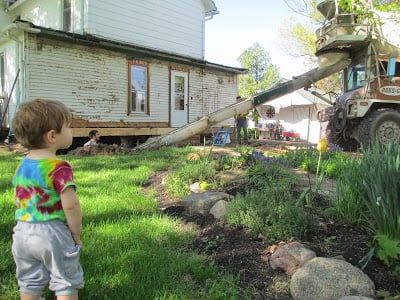
Cement trucks are pretty fun to watch.

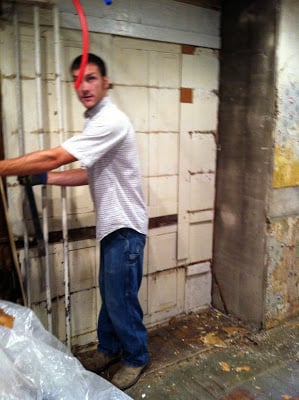
The picture below gives you an idea of just how far we gutted the entire kitchen.  Our house has no insulation.  So the plaster and lathe were removed so we could properly insulate the kitchen and put up new dry-wall.  This little area where our contractor Perry stands was originally a "pass-through cupboard" (I have also heard it called a lazy susan or dumbwaiter). The cooks passed food through a cupboard to be served in a dining room located at the front of the house.  Our dining room is currently used as an office and shipping center (where all the soap, honey, and candle packages on Etsy get packed to be delivered!).  This is partly why we wanted to expand the kitchen- so there would be more room to eat in it, since we rarely would walk to the front of the house to use the dining room.


The back wall was removed... what a fun couple of days that was!

Our former kitchen had 70's style stock cabinetry that I painted white when we moved in (in 2006).  We removed all the old cabinets, and I saved half of them to be used in our new laundry room.  I painted them a nice greenish-blue color, and painted the handles and knobs matte black.  Money saved is money earned, right?
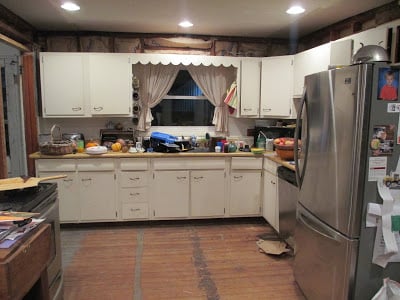
This picture shows our kitchen before we tore out the cabinets, but after
we had torn out the laminate wood flooring.

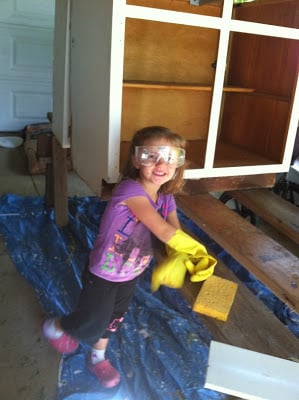
My handy painting assistant.
The picture below was taken by Maizy.  I like it because it shows the random disorganization that took over our honey house area for several months.  Cabinets propped up waiting to be painted, knobs and hinges strewn around Isaac's work bench, trim boards awaiting stain.  We still have piles of old water pipes which were removed from our basement, sitting near the drive-way awaiting a trip to the recycling center.  


I was without a kitchen sink for nearly 2 months.  I have discovered that nothing happens as planned when doing a renovation of this size.  I tried to be a gracious, patient wife, while bending over and washing dishes in the bathtub.  Our contractor (Isaac's cousin Perry) finally made me a make-shift kitchen sink in our new laundry room while we waited the extra weeks for the cabinets and countertops to arrive.   We adjusted.  These are clearly first world problems, after all.

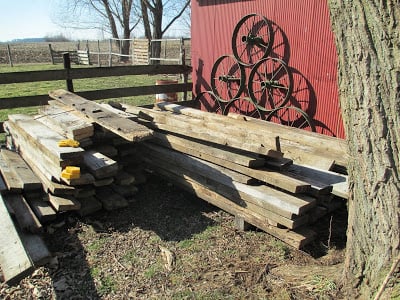
Back in February Isaac picked up several truckloads of oak barn boards from 
an old barn that had fallen down on St. Rt. 104.  We had these boards planed by
Schlabach Woodworks (near my hometown) and made into
hardwood flooring and countertops for our kitchen.
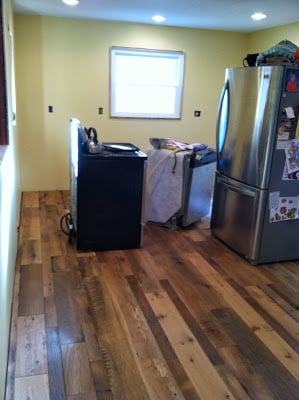
The kitchen- after the new flooring went in but before
the kitchen cabinets arrived.

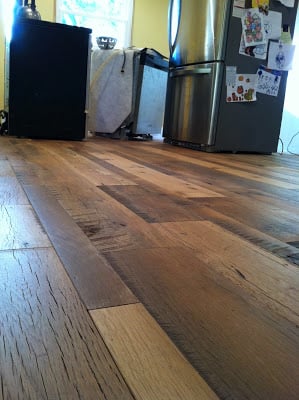
Close up of the floor.  It was planed just enough to make
it smooth enough to clean and walk on.  But you can still see
the saw marks and wear of the barn wood.  I love it!


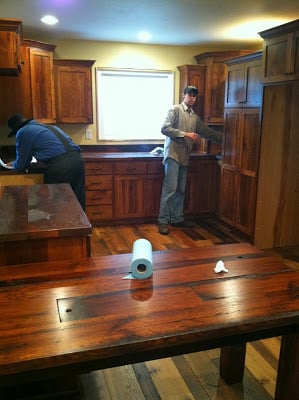
This picture was taken the day our cabinets and countertops
 were installed. Our Amish craftsman, Eldon Hostetler was
figuring up our bill (ouch, that's a lot of honey money!)


 So we're not completely done with the remodel, but it is getting close to being finished.  I finally have a kitchen sink again.  I'm attempting to organize and make sense of this amazing space.  I hope you enjoyed this little tour of our remodel project!  I know I always enjoy reading about others' remodels on blogs.  If you would like references to any of our project contractors I have links and phone numbers listed below:

Flooring:  Schlabach Woodworks (if you want flooring like this you need not gather the barn wood yourself- they can source it for you).  6660 SR 241 Millersburg, OH 44654, Phone: 330-674-7488

Cabinets:  E Hostetler Woodworking- Mt. Eaton, Ohio - 330-698-3661 (He is Amish so this is just a message phone- he has no website or Facebook page for this reason as well)

Perry Barnes Construction: Isaac's cousin- general contractor and general problem-solver.  Send us an email if you want his contact info.  He is currently pretty booked up with local business!


Bridger T. Mountain Man

Honeyrun Farm

-Posted by Isaac

Two years ago today, my birthday, Jayne gave me the most amazing and precious gift.


 Bridger Thomas Barnes, nicknamed "Bridger T." by my dad then re-nicknamed "Bridger T. Mountain Man" by Maizy who was trying to connect the dots between mountain man Jim Bridger and the name given her new baby brother.
I've got a phone full of Bridger pictures so this being our special day, I thought I'd give the bee talk a rest and highlight our little mountain man in action. He's really becoming accomplished at a variety of trades.

Like:
Wrangler- Leader of men, tamer of the wild:


General Contractor- Hauling rocks, mowing rocks, shop work with Daddy:


Woodsman:

Archer- Training for a future Hunger Games

Scholar and teacher- (when big brother needs help)

Commercial Pollinator:


(and official pollen taste tester)

Proficient Garden Walker:

Technician:

Life Guard:

And of course, Mountain Man: leader of midwesterners through the alpine wilds.

I have little doubt, he'll someday carry me up those rugged slopes.

Let Us Give Thanks For Good Food

Honeyrun Farm

-Posted by Isaac

We all need rich, wholesome and diverse diets.
Everyone--
The chickens:

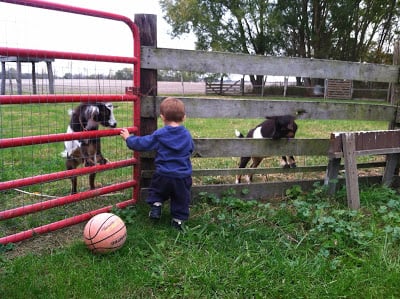
The goats:

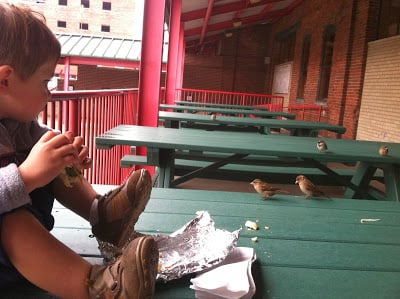
The birdies:

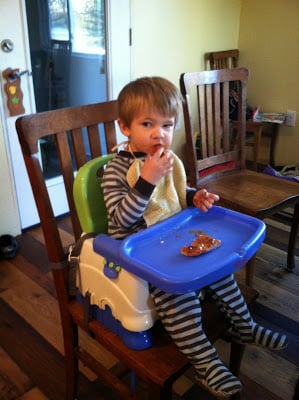
The babies:

 The piggies:

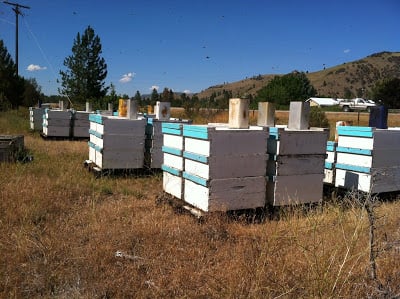
And of course, the bees:
This was an interesting Montana bee yard. The hives had feeders on in the middle of the summer. My only guess is that this beekeeper is ignoring the income (and work) of any potential honey crop and simply prepping the hives for the big pollination money that comes with California almonds.

We're not set up for almond pollination, so we've got to buckle down for another long Ohio winter:

Any well populated hive weighing under 60 pounds or so will need supplemental food.
This constitutes maybe a quarter of them.
It's time to start winter feeding our girls. The patty in the above photo is a sugary blend of fondant, Honey Bee Healthy, lemon juice and cinnamon.
I like to experiment. The cinnamon idea came from Jim Doan, the commercial beekeeper who was interviewed in the Time Magazine article about CCD. He puts a "healthy dose" of protein and cinnamon in all of his hives. Claims the cinnamon is good for the bees' digestion.

Of course in November it's too early to be thinking protein. That will have to wait until March when the bees are brooding up. My hope is that the bees lugged in a heavy dose of ragweed, goldenrod and aster pollen. And so much more to add to the mix... the rich, wholesome diverse diet I started talking about.
The bees know what they're doing.

Incoming ragweed pollen
This is good stuff. Bridger can attest:

But...
Just like humans, bees don't always forage on the right thing. (Who doesn't like Pepsi, Doritos, ice cream, etc...?)
Here I caught them on some field corn in July:

Corn pollen has a low protein content and is basically nutritionally devoid.
Why are the bees on it? Well, that's what's available. As I alluded to in the Big Ag post, sometimes corn pollen is about the only thing out there.
Not good.
 And even worse...
I know at least four commercial beekeepers who blame seed treated crops (such as corn) as the root cause of colony collapse. The seed treatment, a systemic pesticide, ends up in the pollen of the plant... the bees carry the pollen back and at some point in the next year it gets fed to the brood.
Is this really to blame for CCD?
I sure don't know, but it gives me something to worry about. As I said in that previous post, a corn field may as well be a parking lot if you're a bee. My fear (as Jim Doan points out) is that we're now talking about pesticide laced parking lots.

Diversity is the key; variety in the diet for bees, humans and about everything else. Randy Oliver (commercial beekeeper and fantastic educator) talks a bit on the subject in this video:

Now that just made me hungry.


Happy eating, everyone! Make sure you keep some color on the plate...


Etsy Craft Series - A Collaboration with Whole Foods, Upper Arlington

Honeyrun Farm

-posted by Jayne 

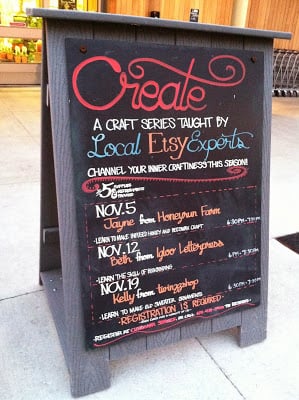
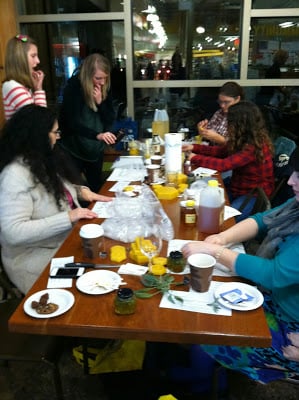
This week on Wednesday I participated in "Create" - a craft series offered by Whole Foods in Columbus, featuring local Etsy artisans teaching a variety of craft classes.  I taught a class on making infused honey and beeswax lip balms.  It was a lot of fun, and of course Whole Foods made the whole experience inviting and casual.... great snacks and a welcoming atmosphere.  

As you can see there are two more classes open
for registration.

We used a very simple recipe from the book I co-authored, Honey Crafting.

Basic Lip Balm Recipe:
.75 oz beeswax
1.5 oz apricot kernel oil (you can use other oils such as almond, coconut, sunflower, or grapeseed oil)
.10 oz essential oil or flavor oil

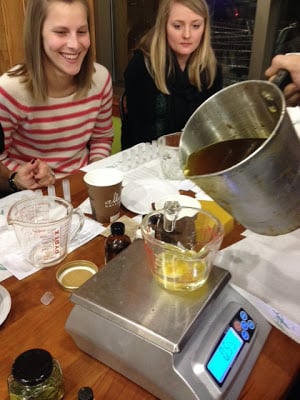
I changed the method from the book just a bit, since I wanted each participant to make and pour their own batch.  Instead of warming the beeswax and oil together in a double boiler, we just warmed the beeswax in a double boiler, combined it with the oil in pyrex measuring cups, and then re-warmed it just enough to melt them completely in the microwave. Each participant added their own choice of essential oils, poured it into lip balm tubes, and they were ready to go!  

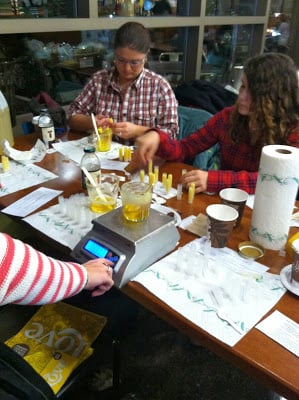
Class participant and fellow Etsy Team Columbus member
 Kellie Gedert and her daughter Cassie work on filling their lip balm tubes.

Carefully pouring hot beeswax in to oils

Half the class worked on creating infused honey
while the other half worked on their lip balm.  


To create the infused honey, we used a variety of fresh and dried herbs, chopped them to bits, combined with any dried spices they desired, and mixed it with honey.  I instructed them to stir the mixture several times over the next few weeks, strain out the herbs, and enjoy!  They simply need to steep until the desired flavor is achieved.  Herbs and spices we worked with included:  Dried Lavender, Dried Lemon Verbena, Fresh Thyme, Fresh Rosemary, Fresh Sage, Spearmint, Cinnamon, Dried Ginger, Cloves, and Nutmeg.

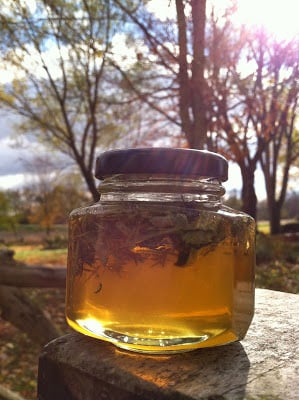
My own honey infusion, with thyme, rosemary, and sage.
I like to use a mixture like this in homemade pizza dough
or as a glaze for chicken or ham.
I also showed the group our Refractometer which measures the moisture level of honey.  It is important when making your own infused honey not to add ingredients that have too much moisture (fresh fruit for example).  When the moisture content of honey goes over 18.5% it can actually ferment.  Storing this type of honey blend in the refrigerator is fine, but it will not be shelf stable like traditional honey.


A refractometer used to determine
 the moisture content of honey

To use the refractometer we drip a bit of honey on the top part underneath the glass.  The bottom part operates similar to a microscope, except you look through the refractometer towards the light, and it shows the moisture content (or the index of refraction... to be scientific).

You don't need a refractometer to make infused honey at home, just be aware that adding too much moisture can cause fermentation of the honey.  Choose your herbs and infusions wisely!  Isaac and I used to make huckleberry honey when we lived in Montana and although it was delicious, it definitely needed to be stored in the refrigerator.

You can catch us at both the North Market and the Worthington Farmer's Market this weekend.  I plan to bring an abundance of fresh rosemary that is growing in our hoop house, so if you'd like to try making your own rosemary infused honey, here is your chance!

Buckwheat!

Honeyrun Farm

-Posted by Isaac

This summer we conducted a grand experiment in trying to produce buckwheat honey.

Actually, we've been fooling around with buckwheat for three years now, little half-arce plots on my sister's produce farm and experiments in the garden.
We knew that buckwheat grows fast, four weeks to bloom, and we knew that the bees love it.

Although we've had many buckwheat requests over the years, we just didn't know if it would be worth it to try and produce the black, rich, bold honey.
This year the opportunity presented itself. My brother Justin, the progressive grain farmer, had twenty acres of rye growing as a cover crop. He planned on harvesting it for seed in July then planting something else to go into winter. Buckwheat didn't exactly fit the bill, but Justin is a good guy and through my brotherly persuasion we got the buckwheat idea rolling.
While waiting for the July planting, we decided to do another garden plot: 

"The throw-down" -- Bridger's seeding technique.

This small area isn't exactly enough to make a honey crop, but it's fun to watch the bees on the buckwheat.
Plus we're somewhat lazy gardeners and cover cropping most of the garden with a thick legume meant minimal weeding during the dog days of August.
(Why sweat over onions and tomatoes when good ol' Sis at Dangling Carrot grows six acres of produce just a mile away!)

Raking in the seed meant a speedier germination.
Planting


Week  Two / Three

Week Four / Five
The garden plot was fully bloomed by the time the rye finally came off Justin's field.
We were ready to plant some real acreage.
900 lbs of seed -- a lot of buckwheat

The seeds, up-close
It's unusual to see a planter out of the barn in late July. 
As I said, Justin is a progressive farmer.
Work faster! 

Mason wants a shot at planting.

This picture was taken about four weeks after planting. The field got whiter and more beautiful as the days went on. We had a few questions from our neighbors... buckwheat isn't a normal thing around here.
You can see one group of hives in the distance. I had 31 total to forage on the field.

During the buckwheat growth, I was busy with summer honey. After a few bee yards had been pulled and extracted, this spot (only a mile from home) was convenient for cleaning out wet supers. I've learned the hard way-- when wet sticky supers are left in piles around the honey house, you attract a lot of craziness.

Here's a video shot during one of these clean-outs:


In September I got around to pulling the buckwheat honey. I was a little disappointed with the quantity, but not all with the quality:

Rich, thick and black as ink. The above picture is interesting. Even though the honey is black, newly drawn wax is still bright yellow.


It has a very robust, smokey taste. It's darker than even the tulip poplar honey. I'm proud of it, I have to say. Jayne thinks it has a sweeter aftertaste than most buckwheat honeys because the goldenrod came into bloom while the supers were still on. The bees spent the mornings on the buckwheat and the afternoons making regular fall honey, mixing the two. They also brought in an abundance of beautiful orange goldenrod pollen. Twelve of the hives had pollen traps... we were double-dipping.

Come on out to a market and try it!

I'll still be at the North Market through November and Jayne starts the Worthington Winter Market this week. This year we're at Worthington every weekend.