Contact Us

Use the form on the right to contact us.

We respond to most emails within 24 hours.  

9642 Randle Rd
Williamsport, OH, 43164

Honeyrun Farm produces pure raw, honey, handcrafted soap, and beeswax candles in Williamsport, Ohio

Blog

Skunks and Bees

Honeyrun Farm

-posted by Jayne

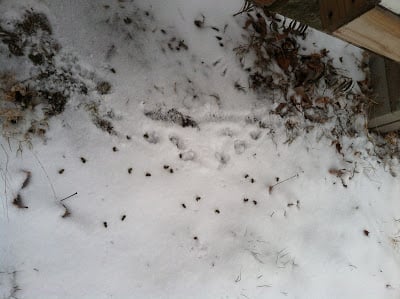
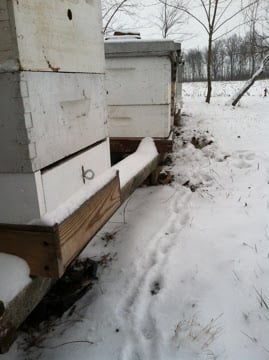
Earlier this week, Mason and I went out to look at the hives, and found some tracks in front of and around the hives.  My first thought.... skunks.

Did you know that skunks love bees?  I remember hearing once at a beekeeping conference that skunks can eat the entire population of a hive in just 3 nights.  I also read on bee source that another sign that you have a skunk problem is little piles of dead bees, as the skunks suck out the juice and then spit them out.  I have also heard that they eat the entire bee, and don't mind getting stung.  

Piles of dead bees:  Skunk carnage.
Breeding season for skunks is from February through May, and they can travel up to 5 miles during this time.  We often start to smell skunks more often during this time of year, and see them around the farm.  If you are a beekeeper, it is a good time to start monitoring your hives for skunk damage.  I believe they are less of a threat when it is cold and the bees aren't flying, since they are less likely to come out to defend the hive.  But the snow will help you see tracks from these predators, and monitor what is going on. 

Simple and Broke

Honeyrun Farm

-Posted by Isaac

It's almond pollination time in California. Big business for beekeepers. No, not us, but I do enjoy thinking back. 
Some poor worn out schmuck is right now riding an eighteen wheeler loaded down with about 500 hives. He's been up all night, and now it's the next day, and he's bleakly looking out at a desert road, thinking... what the hell...??
I was that guy for a season of the almonds. You can read about it in last year's 'Super Bowl of Beekeeping' post. Somewhere in those many thousands of miles I was able to draw a song out of the experience. 
So, for our wonderful blog followers, here you go-- a special treat.  Well, maybe...


What Do Bees Do All Winter?

Honeyrun Farm

-Posted by Isaac

What do they do when it's cold outside?
Occasionally we get asked this question at the  winter markets.
Do they migrate?
Do they hibernate?


 Last winter, Jim Tew from the OSU bee lab jokingly told a reporter that wintertime bees mostly  "hang out, drink beer and watch TV..."
This left some Columbus Dispatch readers scratching their heads, and poor Mr. Tew was pressed into explaining what he meant by that for several weeks following.
What he was essentially saying is that bees don't do all that much. No hibernating, no migrating, no foraging. In cold wet Ohio, they mostly just try to stay alive.
Every so often we get a day with the temps rising above 50 degrees, and the bees are able to get out and take "cleansing flights." Our 65 degree January day this week was just the ticket.
("Don't go believin that Climate Change crap!")
("Them scientists don't know nuffin!")
Cleansing flights

With the advent of this tropical January craziness, Mason and I got out to check a few hives.

Mason dons the new bee suit
 Here's what bees really do in the winter-- they cluster. They form a tight ball with the queen in the middle and vibrate their wing muscles in order to produce heat. In this cluster, there is a slow rotation of outside bees working their way in, and vice versa. Producing the heat requires fuel, and this is why bees need a hefty store of honey going into winter. As the winter toils on, the bees slowly eat their way upward through the frames of honey.
Loose winter cluster
Here you can see a cluster that has worked its way up to the top. They are eating their stored honey and are almost through with the protein/ honey patty I gave them in the Fall.

If the hive is light weight, and maybe 20% of ours are, we give them a five pound fondant patty to play around with.

A light hive means the bees have eaten their way through most what little winter stores they had. We make many July and August splits (small hives, new queen), so we sometimes run into this food problem. Especially if the bees, for whatever reason, didn't collect much goldenrod and aster nectar.
If you're wondering, the little ball in there helps with the condensation rolling down the sides of the bag instead of falling  directly on the bees.

As I said earlier, the winter is mostly a fight for survival, and as always there are a few casualties.
This is a small hive that died, not from lack of food, but simply because the cluster size was too small to produce enough heat. Without heat the bees are immobile, and they can't move enough to travel the few inches to their stores. I pulled a frame up to show a cross section of the dead cluster. This cluster was only three frames in width. Way too small.
"The Fallen"
February and March are the critical winter months for feeding and checking bees. The queen has been laying, and the brood nest size is increasing. The bees instinctually keep the brood warm above all else... even eating. If we get a two week cold snap it could spell disaster if the bees are not close to a food source. I'm talking inches.
Therefore, in a couple weeks, things get busy. We go around making sure our girls are fat and happy.

Support Local Restaurants - Support Local Farmers (and Beekeepers!)

Honeyrun Farm

-posted by Jayne

We recently began selling our honey to two Columbus restaurants:  Knead Urban Diner, and Barley's Brewing Company.  Naturally, we decided a date was in order to check out how they were using our honey.  We decided to give Knead a try, with our youngest child in tow.  I am happy to say the restaurant is very kid-friendly, while also having an upscale feel to the place.  The great thing about Knead is that they really do work at sourcing as many local ingredients as possible.  So many grocery stores and restaurants out there are just "local-washing" with their advertisements.  Knead is not just "talking the talk" but actually "walking the walk".  Just think how much easier it would be to call up the GFS truck and get everything delivered by one company.  Instead, Knead must contact and work with many small farmers and business owners to source locally grown food.  They also make everything they can from scratch.


I'm not sure why I didn't think to photograph our food when it arrived, but it was really impressive (visit the website to see some pics).  Very large portions, nice presentation, and extremely delicious.  Isaac ordered the famous, "Motherclucker Sandwich" which features "a kiss of local honey."  I got the Cuban, with locally sourced pork and Guggisberg baby Swiss (made in my hometown).  Their french fries and house-made ketchup is worth the extra $3 on the side.  Our baby Bridger concurs.

Knead's map shows where they source their local ingredients.
 Knead was voted best new restaurant by Columbus Monthly and Columbus Underground.  They are also in the running for "Best Burger" in the Columbus Alive "Best of Columbus" dining section.  If you agree that this place is phenomenal, why not cast your vote?  If you've never been to Knead, I highly recommend you give it a try.

Beeswax Processing

Honeyrun Farm

-Posted by Isaac

It's been a tough week for the Barnes clan. All of us except Mommy came down with the flu or a bug of some sort. So Jayne had to play the role of nurse in a house filled with coughing, hacking, spitting, gagging, vomit, urine, tears, crying, moaning, whining, outright screaming and gnashing of teeth...
And, after me, she had three sick kids to tend to. Sometimes I just don't know how she does it.

But now it's Saturday morning, the weather has turned warm and beautiful, Mommy is up at the Worthington Market and I've got the kids. I think we'll go on a picnic to Hargus Lake.
 Before we go, I thought I would get this up -- the long awaited beeswax post. I've had these pictures stored since September, so it's about time. Sometimes we get questions about how the beeswax candles are made, where the wax comes from, if they're pure, etc...
So here you go, in more pictures than words, our wax processing:

The bees have a gland that produces wax, and they have an obvious purpose for it; building of comb. The comb not only serves as their home, a place for larvae, and rearing of young, it also serves as food storage. This is where they put the pollen and honey. When a frame of honey is dried down to around 17%  moisture, the bees will seal it off with a wax capping.
When the honey comes into the honey house, the first job in extraction is to remove this wax capping so that the frames can be spun and the honey will flow out:
Cappings wax
After several weeks of draining, I take the nearly dry wax outside and let the bees eat the little bit of honey they can get to.

 The wax is then put into a melter set at 180 degrees.

The burlap bag serves as an initial filter, straining out dead bees, wood chips from frames, leaves, etc...
Dripping a few minutes
The melted wax is then ladled off the top:

...and poured into forms which will sit and wait for further cleaning:


 After several rounds of this, what comes off the bottom of the melter tank is basically burnt honey. This, we sell as our high priced Christmas blend.
(Kidding!)
Melter honey
 At the end of the season the further cleaning part starts:
Additional filtering
 The wax is remelted (160 degrees), again ladled off the top, and this time run through a 400 micron filter in order to catch some of the smaller pieces of dirt. You can see where the "clean molds" end up, awaiting their fate:
 Candles being the fate for most of the wax. Although a fair amount is just resold in smaller sized blocks to people doing their own craft.
 The larger clean molds are chopped into small pieces then put into a double boiler for the final pour.


 December is a busy time for beeswax candles as everyone seems to want that perfect unique handcrafted gift.
-posted by Isaac