Contact Us

Use the form on the right to contact us.

We respond to most emails within 24 hours.  

9642 Randle Rd
Williamsport, OH, 43164

Honeyrun Farm produces pure raw, honey, handcrafted soap, and beeswax candles in Williamsport, Ohio

Blog

Comb Honey

Honeyrun Farm

-Posted by Isaac

Wow, how time does fly in the summer. It's been over two weeks since our last post. Busy busy on the bee farm. The summer honey is just caked in the supers and I'm exhausting myself on these hot afternoons pulling it off the hives, getting it to the honey barn and eventually extracting. The recent rain has been a welcome relief.

I thought I'd show you a little of the comb honey we got into last week. 

These things are called "Ross Rounds." They're a real pain in the butt to produce, but as you can see, the end product is beautiful. I tell other beekeepers that if I had to do it over with comb honey, I'd never go with Ross Rounds. The bees seem to avoid them like the plague, and you just about have to find a hive on the verge of swarming to really force the bees up into the super.


There's something they just don't like about the small round space with a thin sheet of wax foundation.

Alas, the bees eventually cooperate, and draw out some comb. A decent nectar flow definitely helps.

You can see that these supers are not your run-of-the-mill bee boxes. Specialty items like this always incur some expense. That's why we're sticking with the Ross Rounds-- too much money wrapped up in them!


A selling point with the Ross Rounds is that the honey is never touched. The round section comes exactly the way the bees make it. After freezing it for a day to kill any unseen wax moth eggs, we simply pop the section out and put a lid on it.

You can see that they don't all come perfectly capped off. (One on the far left) 

These not-quite-done sections are turned into chunk honey.
A tasty job that Julia just loves.

This cut comb will later be surrounded by beautiful translucent summer honey.

Of course you can find both comb and chunk honey by visiting us at the farmers markets. Please come out and see us on Saturdays! Worthington and the North Market.

Or make the trip down to the farm stand on Randle Rd. It's cheaper in the country.

I mentioned being busy with pulling the summer honey... as an excuse for the recent slack on this blog. I thought this picture might catch your interest. As in, it's not something you see every day. This is what  a thousand pounds of honey looks like in the back of a truck:

Thanks for reading a little about our comb honey production.  If you're curious enough to want to try one, head on over to our Etsy store.
Hopefully by the end of the season we'll have five or six hundred of these sections ready to decorate kitchen tables around central Ohio.  

Sweet Summer

Honeyrun Farm

-Posted by Isaac

It's been really dry as you know. I don't think we've had a meaningful rain in six weeks. This means that flowers conserve nectar, thereby limiting the summer honey production. This is what I'm seeing in the hives-- some honey, but not a huge amount. I'm glad our hive count is up this year.

Some plants do well in dry conditions. Lavender is one. This is a row Jayne and I planted three years ago:


We went to a lavender festival in southern Ohio a couple weeks ago, and watched women in Sunday dresses snip little sprigs of lavender. For me, it's much more enjoyable to watch our own naked ladies sample the lavender.

                                                 Wow, can she use her tongue!

I was on the phone with Jim North (friend, beekeeper, Jedi master) and noticed a cloud of bees moving over the cornfield. As I watched and talked, I observed that the swarm was directing itself toward one of my very own hives. Walking out there, sure enough, they were moving in!

 I told Jim what was happening, and he said that sometimes you get a "hostile takeover" of a small hive.  That's exactly what I witnessed. This was only a two frame split, and apparently the swarm decided that there was plenty of unused space in there. I checked on them yesterday evening, and the box was full of bees-- swarm bees. We had a few casualties out front, but all in all I think I'll take the swarm.

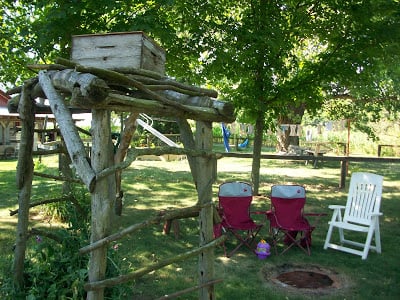
Speaking of swarms. We caught number thirty of the season a few days ago. They moved into a trap, I brought them home, hived them, and the next day they were out on the limb of a small locust tree. I guess the home I gave them didn't suit. Later that morning I noticed that the scouts were checking out the very box that they had originally been trapped in. So I put the trap on top of the trellis to see what would happen:
 They moved in! Right over top of the fire pit. This makes Jayne a bit leary when we have company, but I think it's a nice conversation piece. Who wouldn't want to watch stinging insects fly home right over one's head?

We're making more splits using Koehnen queens from California. Carniolans. I've been noticing that hives with these queens do much better then the Georgia queens.  Makes me think of that Beach Boys song... "Wish they all could be California... girls..."


Mason helped me with the cork and candy plugs that go in the cages.
Mainly, he seemed more interested in the candy plug.

The bees got a little help from our sweet tooth.

Summer honey is right around the corner.

Bacon Infused Honey and Orange Basil Infused Honey

Honeyrun Farm

This week I've been sampling some new infused honeys that will be used in ways I don't traditionally use honey.  Vinaigrette Salad dressing!  I've been buying salad dressing for too long... it's time to start making it myself.

We were fortunate enough to be a part of the WOSU Chefs In The City program, and during their segment featuring honey they gave a great little idea for a vinaigrette recipe using honey - bacon infused honey to be more specific.  Isaac was also featured in the segment (yes that's right, he is not too manly to wear a hairnet while bottling), talking about our farm, how the bees make honey, other products we make, and all that good stuff.  You can watch it here:


The video doesn't give exact measurements for the recipe, but here are the ingredients, courtesy of Chef John Skaggs from Heirloom :

White Vinegar
Orange Juice
Orange Honey
Bacon Honey
Parsley
Cilantro
Thyme
Olive Oil

I also had a customer at the Worthington Market this week who requested an "Orange Basil Infused Honey."  While I explained that I probably would not be introducing that to our line-up anytime soon, I told her it was a wonderful idea and I would try it at home for my own use.  (I also suggested she buy some of our summer honey and make it herself, too!)  So here's what I did:

 Zest one orange.  Chop fresh basil.  Place inside a jelly jar.  Add honey.   See how easy that was?!


I let it steep for 1 day, then strained it out with my tea strainer.  I used a lot of orange zest and a lot of basil, making a very small batch that would be pretty intense with flavor.  When infusing honey, the one thing you must be careful about is to not add too much moisture to the honey.  Honey will last forever if is has the optimum moisture content (16-18%).  We have a special tool called a refractometer that can tell us the moisture content.  If honey is above 18%, it can actually start to ferment.  So if you add anything with moisture to your honey (such as fresh basil leaves and orange zest), you should use the honey as soon as possible, or refrigerate and use within a few weeks.

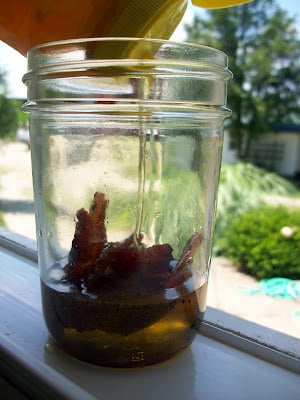
And now the Bacon Infused Honey (sorry, vegetarians):  Fry Bacon.  Put in Jar.  Add Honey.  Steep until desired flavor is achieved.  Eat honey covered bacon for an afternoon snack (yes, it is really good.)  **added note:  I have received several questions about the storage and shelf life for the Bacon Infused Honey.  Like the Orange Basil Infused Honey, you will want to be careful because you have added moisture to the honey.  I recommend refrigerating the honey (even though this will cause granulation, this is not a problem... just gently warm the honey in a hot water bath to re-liquify).  I would also recommend using within 2 weeks. 

I plan to add these to the above ingredients to create a vinaigrette.  
Do you think we should add bacon infused honey to our line?  
Or does that sound too weird?


Spring Honey

Honeyrun Farm

-Posted by Isaac

A few days ago I started pulling the Spring honey off the hives and unfortunately I'm already done. After all that bragging about how great the bees looked building up this Spring, there was surprisingly little honey to be had. Though I did make about 100 splits from the strongest hives. Maybe that had a little something to do with the lack of early honey... fault of the beekeeper, not the bees? Possibly. 

Oh well. The bees are looking strong and active (especially the splits), primed for a great summer nectar flow if there is any at all to be had. The honey that did come off this Spring is beautiful, tasty and dry. Most frames were only partially capped:

Normally this would mean a while in the drying room, but even the completely uncapped frames were testing out at 16% moisture. I guess a dry Spring means dry honey.


The uncapper didn't get much of a workout with so many frames going straight into the extractor.

 We have a "Handyman" uncapper (from Dadant, I think). Although the uncapping knives are run with a motor, the frames are placed in by hand (endlessly) and then cranked down through the machine. This leaves you with tired shoulders in need of a Father's Day massage.
 I had to steal parts from a water pump in Jayne's greenhouse to fix the busted heater pump on the uncapper. (It saved about a hundred dollars and shipping time, but I may never see that massage.)

We didn't get around to snapping pictures until the very last extractor load. You can see the frames on this last round had to be spaced out to balance the machine.

Although the total amount of honey pulled was disappointing (about 700 lbs), it was still uplifting to see the first of this year's crop spilling into pails.

It takes such a short time, and there is so little of the Spring locust honey, I don't bother with tanks or in-line filters. It all goes straight into five-gallon pails.

Gorgeous, delicate water-white honey. And the taste, oh so special...

 You locust honey lovers know that we don't wholesale this. You can only find it by visiting us at a market (or buy it online). This gives me a chance to brag about it face to face.

Although most of the frames were partially or completely uncapped, we did find a few that can go to the Pickaway County Fair next week.
Now that's just showing off!

With the extracting done, today became a project day. First on the list (Jayne's list): a new sandbox.
Here are the kids "helping" me move about a ton of sand by way of wheelbarrow trips across the play-yard.

Next on the list: fix the holes in the chicken pen and move our soon-to-be egg layers.  And build a fire-pit.
Daylights a'burnin!

Balsamic Roasted Carrots - with honey!

Honeyrun Farm

We finally pulled up all the carrots in the greenhouse (which is working more like a hoophouse right now) and planted tomatoes in their place.  In celebration of this momentous occasion, I bring you a tasty little recipe that requires very little effort.  Go find some carrots at your local farmer's market and try it out!  I adapted this recipe from the Alaska from Scratch blog.  

Ingredients

  • 8 medium carrots, sliced lengthwise down the center (I chose not to peel them, and sliced them into quarters for faster cooking)
  • salt and pepper
  • 1T balsamic vinegar
  • 1t brown sugar
  • 2T olive oil
  • fresh rosemary, chopped
  • honey, for drizzling
Instructions
  1. Preheat oven to 425 degrees.
  2. Place carrots side-by-side on a baking sheet. Season with salt, pepper, and chopped rosemary.  Don't crowd the pan, to ensure that they roast instead of steam (I crowded mine a bit too much).
  3. In a small bowl, stir together balsamic and brown sugar until combined. Add olive oil. Drizzle the whole mixture over carrots. Toss to coat.
  4. Roast for 25-30 minutes, or until carrots are crisp-tender and caramelized (cooking times can vary depending on the thickness of your carrots). Drizzle with raw honey. Serve immediately.

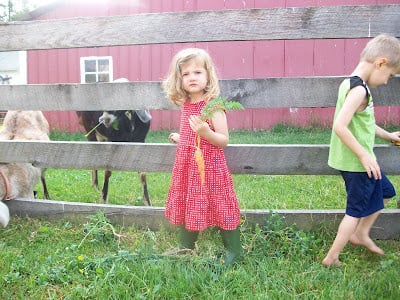
I believe I photographed these carrots more than any other vegetable I've grown.  Why?  Because I was so very proud of them!  Carrots are hard to weed, and in our Ohio clay soil they have a hard time forcing their roots down, limiting their size potential.  But these carrots were kind to me, and grew beautiful and long.  The kids learned they could easily go out to the greenhouse and grab a carrot for a snack (much to my delight).  They fed the tops to the goats and munched on the bottoms while I worked.  
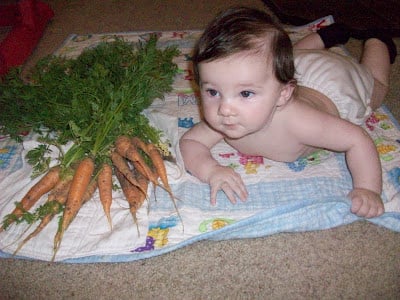
I also found it amusing that I planted the carrots while I was pregnant with Bridger back in October, and as I was harvesting them in May I noticed they were approximately the same length (although Bridger wins on weight).  So naturally, I photographed them side by side.
  
 And then my photographer friend Courtney caught this cute picture of Mason holding these carrots once again during our family picture photo shoot last month.
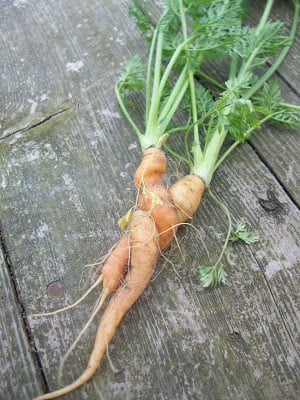
And sometimes the carrots did funny things like wrap around each other while growing, so naturally, another picture was in order.
As you see, these carrots will forever be recorded in history in the Barnes family photo albums.  And so the season goes on, the carrots are gone, and I must find another crop to photograph.  Tomatoes?  Potatoes?  We'll see!
Have a wonderful weekend!
-Jayne